Annualized pilot impact
~$2.7M
Validated through a six-month pilot with a matched control group.
I led ChatGPT Enterprise from a controlled pilot to scaled operating model at Guitar Center, proving measurable value in the contact center, then expanding adoption from roughly ~150 licensed users / ~40 DAU to ~1,000 users / ~800 DAU through workflow design, governance, enablement, and cross-functional trust.
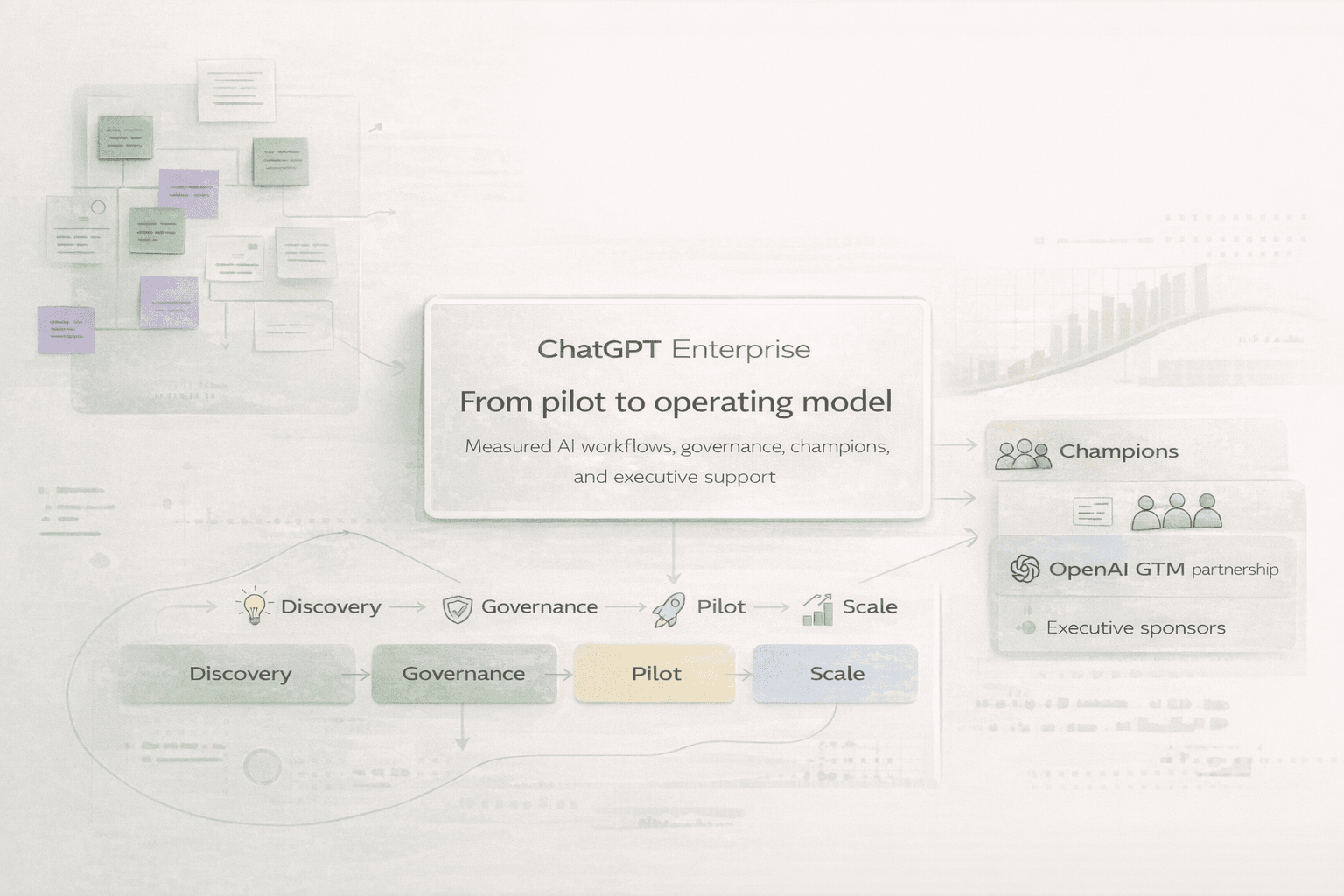
A sanitized view of the path from workflow discovery and governance through measured pilot, enablement, and scale.
Read the caseThe case in one sentence
This was not a broad “roll out AI everywhere” initiative. It was a deliberately scoped product-led experiment inside a revenue-critical environment, designed to answer two questions:
The answer to both was yes.
The headline proof points from pilot validation and rollout scale.
Annualized pilot impact
Validated through a six-month pilot with a matched control group.
Licensed users scaled
Expanded ChatGPT Enterprise from an early pilot footprint into broad company adoption.
Daily active users
Daily usage grew because the rollout emphasized reusable workflows, training, and governance.
01 · Opportunity
The shape of the opportunity and why this was the right proving ground.
At the time, generative AI interest was rising across the company, but leadership needed more than enthusiasm. The bar was not novelty. The bar was a safe, measurable, credible implementation that could demonstrate business value without creating governance risk.
The contact center was the right proving ground. It had clear workflow friction, measurable business outcomes, and high enough operational visibility that results would matter. Agents were spending time on pre-call preparation, drafting, and context switching across systems. If AI could improve that environment in a controlled way, it could become the foundation for a broader operating model.
02 · Environment
The operating environment, constraints, and credibility bar behind the pilot.
This work started inside a high-leverage operational environment rather than as a centralized innovation exercise. The contact center had visible friction in day-to-day work: agents needed faster access to context, better support for on-brand communication, and less time lost to repetitive preparation and switching between tools. At the same time, any implementation had to preserve human judgment and respect governance boundaries.
Leadership also needed more than anecdotal success stories. For enterprise AI to become credible, it needed to show measurable improvement in both revenue and efficiency, not just excitement from early adopters. That requirement shaped the pilot from the beginning.
03 · Friction
The core friction that made this worth solving.
04 · Reframe
The framing that changed what the right solution looked like.
The winning move was not broad access.
The better strategy was to start in an environment where workflow friction was high, outcomes were measurable, and human judgment still mattered. So instead of treating ChatGPT Enterprise like a generic productivity tool, I framed it as a product experiment inside a revenue-critical operating system.
That meant pairing frontline co-design with a matched control group, clearly defined business metrics, practical governance boundaries, and a rollout path that could evolve from pilot to broader adoption. Once the proof point existed, scale became a product management problem: enablement, champions, sequencing, and trust.
05 · Choice
The alternatives considered before the path was chosen.
Fastest path to raw adoption, but weak governance, low measurement confidence, and limited ability to distinguish real value from enthusiasm.
Safer on paper, but too slow to create operating momentum and too detached from frontline workflow reality.
This was the chosen path. It required more upfront design work, but it gave the company the clearest route to trust, executive buy-in, and durable expansion.
06 · Build
How the work moved from strategy into action.
I partnered with supervisors and frontline agents to identify the highest-friction jobs to be done, then translated those into purpose-built GPT-supported workflows. The goal was not general AI usage. It was targeted support in moments where time, clarity, and consistency mattered most.
I worked across Legal, Security, Engineering, enterprise systems, and Operations to define acceptable data handling, review steps, and usage boundaries. This mattered because enterprise AI adoption only becomes real when the guardrails are practical enough for teams to use and credible enough for leadership to support.
The pilot was designed with a cohort and matched control group, using metrics centered on Revenue Per Call, Items Per Transaction, Average Order Value, and supporting efficiency signals. That measurement model turned the initiative from an AI experiment into a business case.
I created training assets, reusable prompting patterns, and the early grassroots version of ChatGPT Champions so the organization could scale from one team to many. This piece is strategically important: the value did not come only from model access, but from making the workflows repeatable, the adoption pattern teachable, and the community around it strong enough to spread good practice.
I translated the pilot into a leadership-ready narrative: concrete business value, repeatable rollout mechanics, and a credible path to broader investment.
Selected artifacts
Workflow discovery exhibit from the early stage of the pilot.
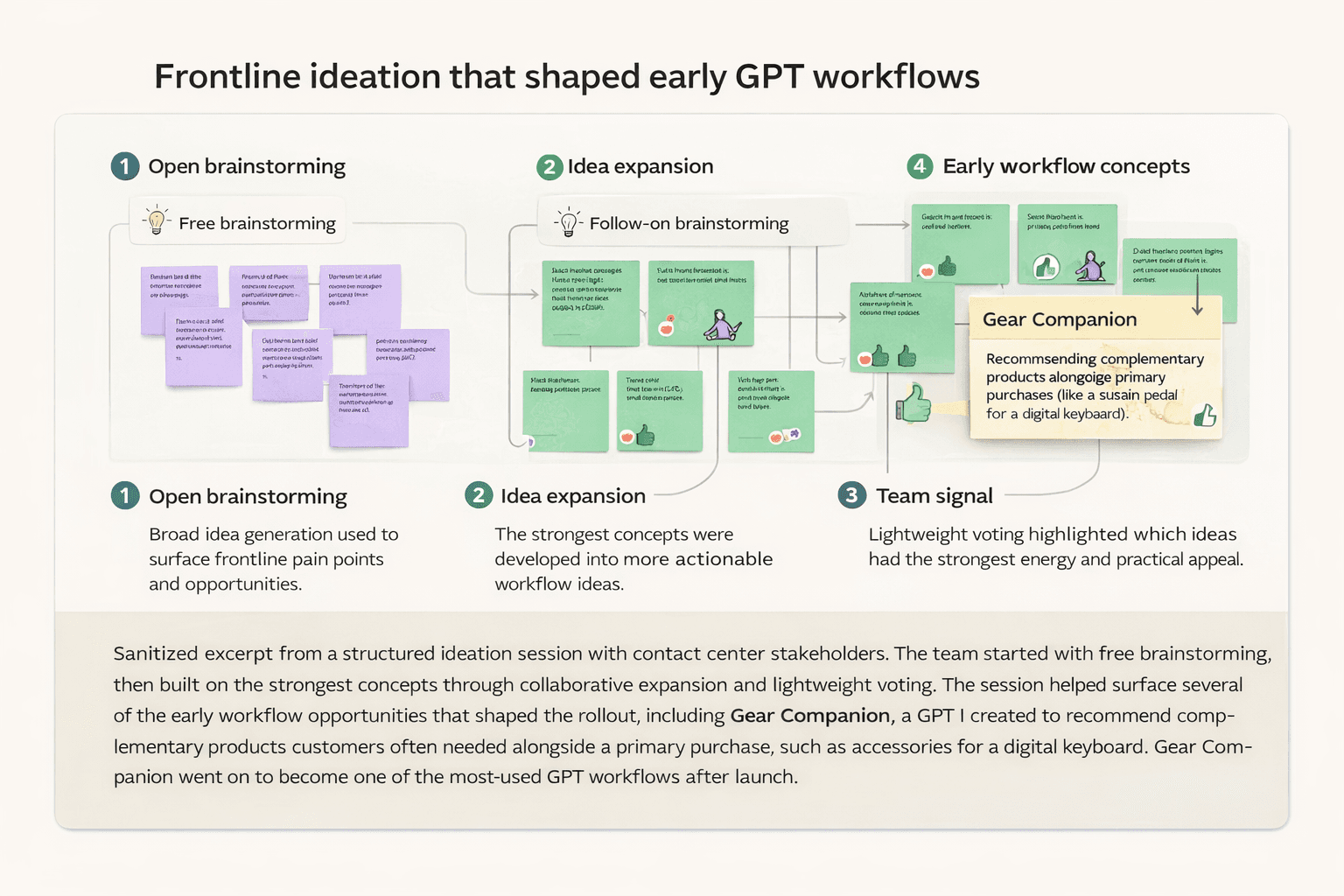
Sanitized excerpt from a structured ideation session with contact center stakeholders. The team started with free brainstorming, then built on the strongest concepts through collaborative expansion and lightweight voting. The session helped surface several of the early workflow opportunities that shaped the rollout, including Gear Companion, a GPT I created to recommend complementary products customers often needed alongside a primary purchase, such as accessories for a digital keyboard. Gear Companion went on to become one of the most-used GPT workflows after launch.
07 · Proof
What the pilot proved and what that unlocked.
The pilot proved two things at once.
First, AI could create measurable value in a frontline workflow. Second, adoption would scale when enablement and guardrails were designed as part of the product rather than added later.
The initial six-month pilot produced an annualized impact estimate of ~$2.7M, with pilot agents outperforming a matched control group across revenue and efficiency indicators. That proof point became the basis for expanding ChatGPT Enterprise from roughly ~150 licensed users / ~40 DAU to ~1,000 users / ~800 DAU across the company.
08 · Scale
The system that made the initial proof point durable.
The most important outcome was not just the pilot result. It was the operating model that came out of it.
The rollout became scalable because usage patterns and governance were designed together. What emerged was a reusable system for enterprise AI adoption: workflow discovery, governance, measured pilots, enablement, feedback loops, and clear boundaries for use.
What scaled beyond the pilot was not just usage, but the system around it. Alongside workflows and governance, I helped build the human adoption layer through a grassroots ChatGPT Champions model that surfaced strong use cases, spread practical best practices, and created momentum across teams. Over time, that effort gained broader cross-functional structure, partnership with OpenAI GTMs, and C-suite sponsorship, helping turn early momentum into a broader enterprise capability.
The operating model and champions layer below show how the rollout scaled through governance, enablement, community, and executive backing rather than broad access alone.
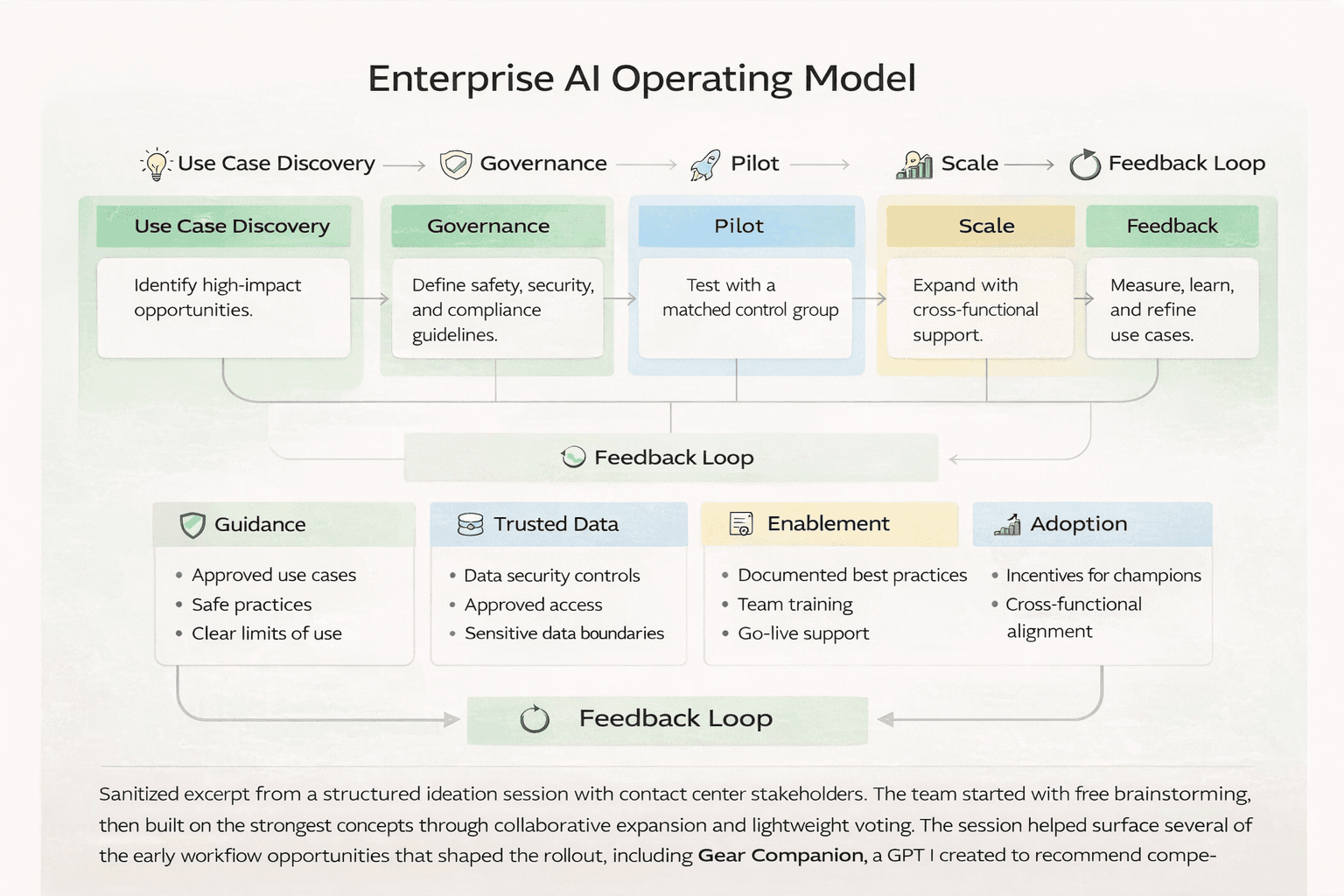
Sanitized view of the operating model that helped ChatGPT Enterprise move from pilot to scale. The rollout combined use-case discovery, governance, measured pilots, enablement, and feedback loops so adoption could grow without losing trust. This system made it possible to move from an initial proof point in the contact center to broader enterprise usage.
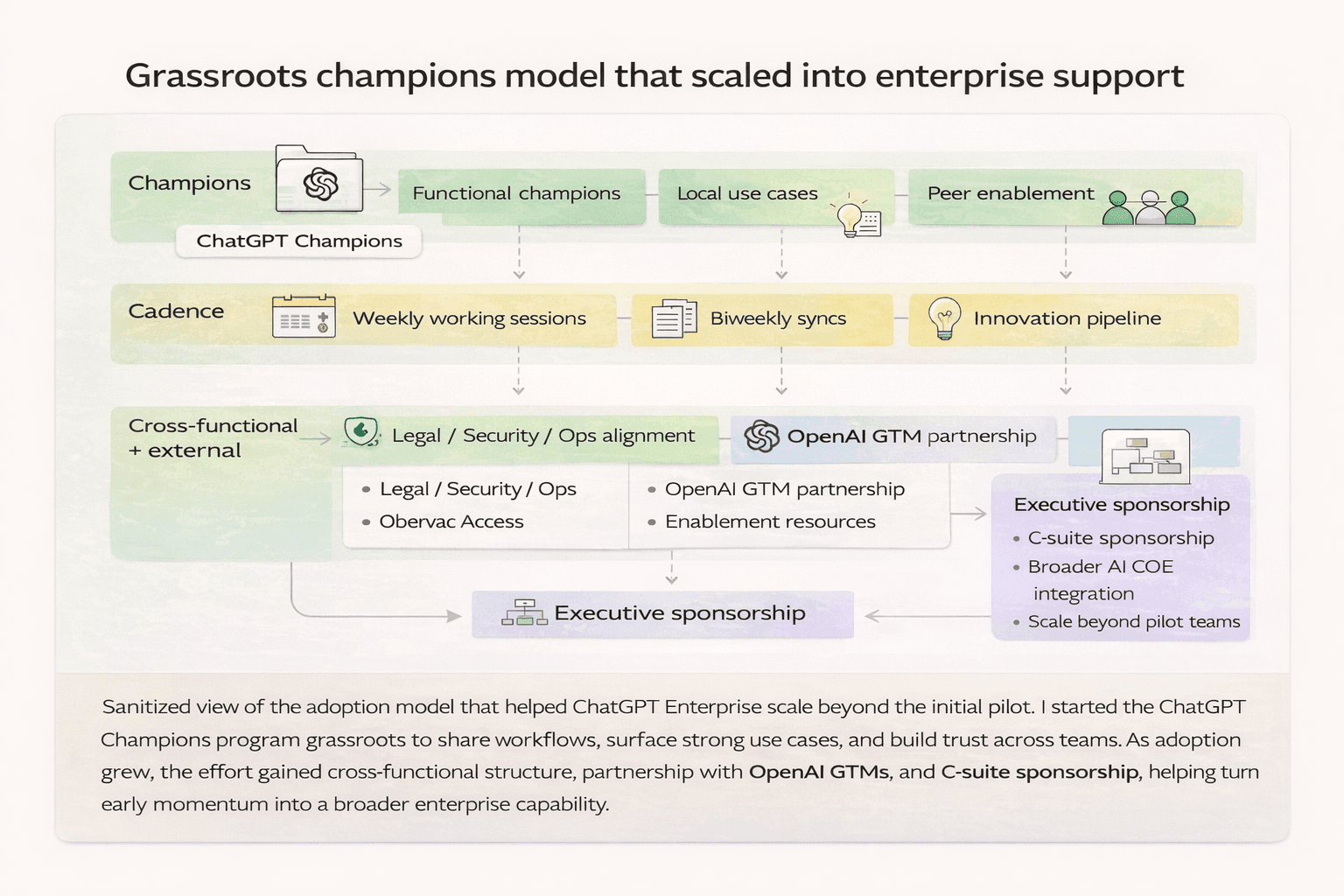
Sanitized view of the adoption model that helped ChatGPT Enterprise scale beyond the initial pilot. I started the ChatGPT Champions program grassroots to share workflows, surface strong use cases, and build trust across teams. As adoption grew, the effort gained cross-functional structure, partnership with OpenAI GTMs, and C-suite sponsorship, helping turn early momentum into a broader enterprise capability.
09 · Reflection
The product leadership lessons that remained after the rollout.
This case reinforced a pattern I believe in strongly: enterprise AI does not scale because access is available. It scales because one operating environment becomes measurably better first.
Product leaders have an outsized role in that transition. The job is not just picking tools. It is designing the conditions for trust: workflow fit, measurable outcomes, governance that teams can actually work within, and an adoption model that can spread without falling apart.
That is what turned this from a pilot into an operating model.
Recommendations
A few recommendation excerpts that reinforce the same pattern from adjacent perspectives: strong business partnership, reusable workflow design, and the ability to turn AI experimentation into credible organizational change.
At the tip-of-the-spear of AI adoption — and made sure the whole company was right there with him.
Zac was senior to Daniel but didn't manage Daniel directly
Zac Bogart
SVP of Digital, Digital Marketing Leader, Strategist, & Executionist
March 4, 2026
Built reusable GPT-powered tools, launched the first ChatGPT Enterprise pilot, and delivered huge ROI.
Sumanth managed Daniel directly
Sumanth Cherukuri
AI Transformation | Digital Transformation | AI Innovation & Enablement
December 29, 2025
Contact
I’m happy to share more about the pilot structure, the metrics logic, the operating model, or how the cross-functional alignment worked behind the scenes.