Platform focus
Reusable AI systems
I became focused on what should be reusable across use cases, not just what worked once.
Senior Product Manager, AI Platform Strategy • 2024–2026
This work started with a customer-facing AI prototype, then grew into a broader point of view on how AI adoption really scales inside an organization.
Follow the evidence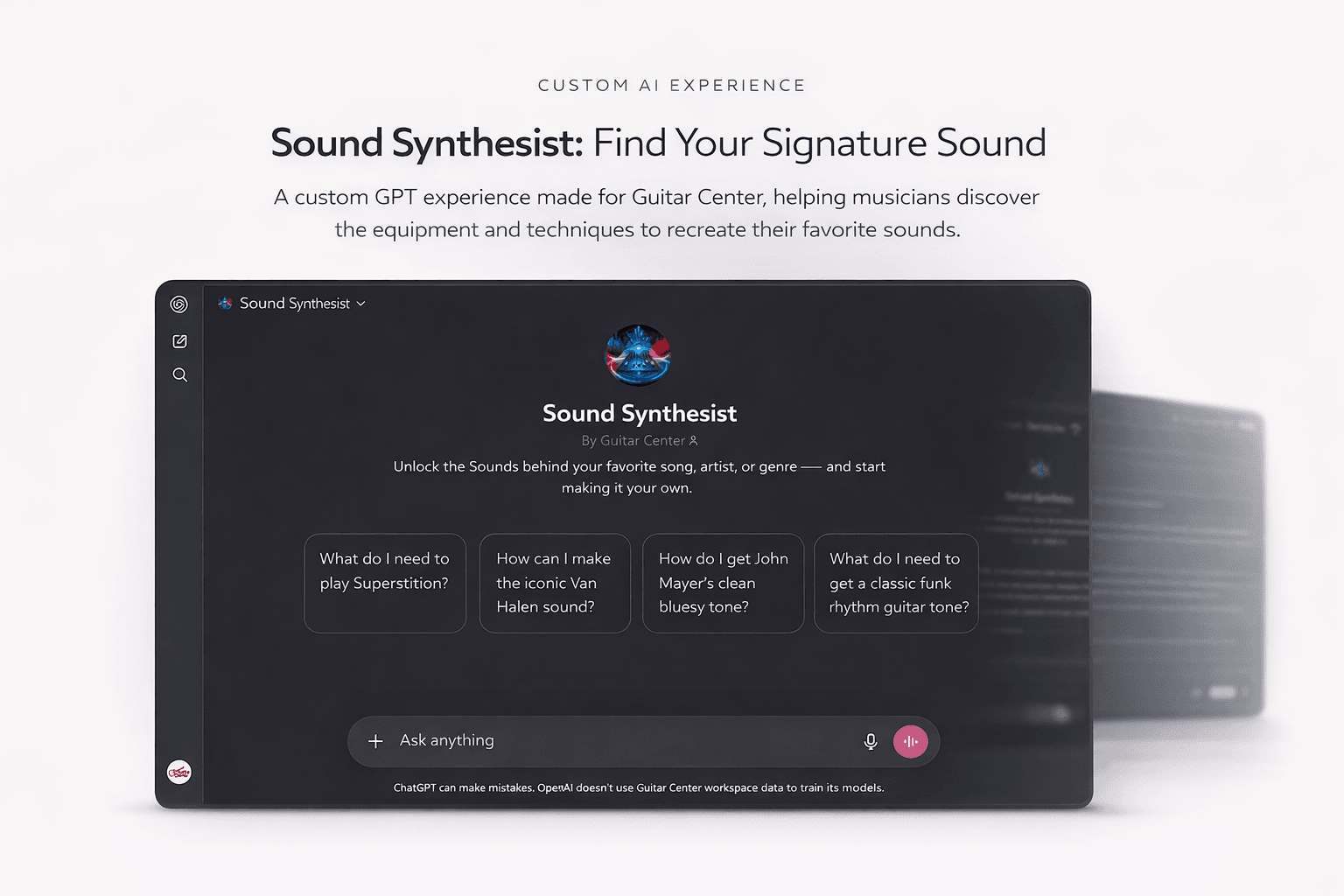
Functional custom GPT prototype
Where this started
During a company hackathon, I led a team to design and build a functional AI prototype for Guitar Center customers.
The concept addressed a real product discovery problem and was envisioned as an experience that could support customers across ecommerce, in-store, and contact center touchpoints.
In a follow-up UX study, 87% of participants said they would use it again.
That result mattered more than the award. It showed that AI could create real customer value quickly when grounded in a clear use case.
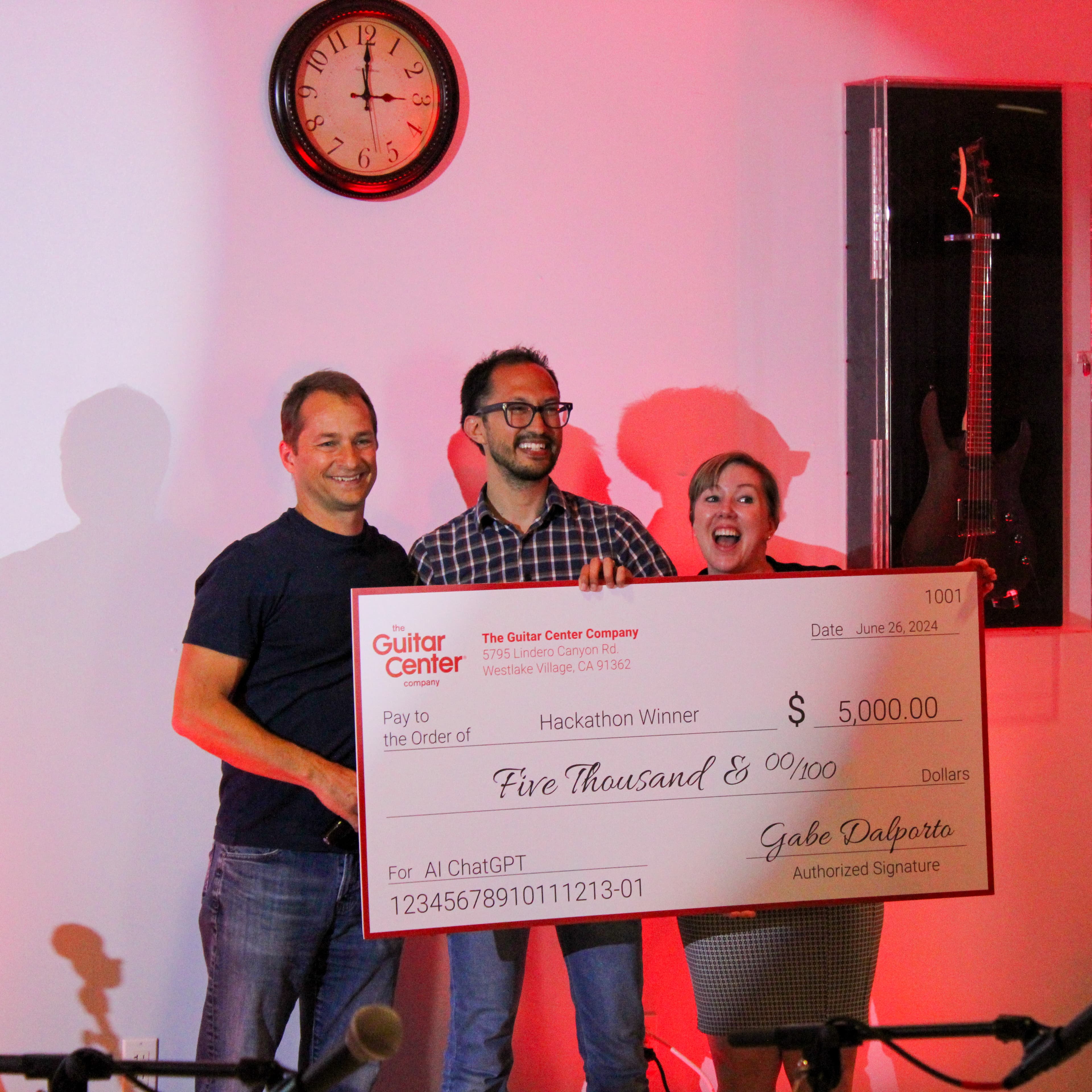
The original hackathon photo anchors the story in the real moment the concept gained internal traction.
A product visual of the experience that made the functional prototype tangible beyond the original pitch.
What changed
The prototype created momentum. It also clarified something bigger:
Early customer validation is not the same thing as scalable adoption.
Turning promising AI ideas into durable value requires more than a strong concept. It requires ownership, workflow fit, reusable patterns, and structural support.
This experience also reinforced how important focused go-to-market strategy is for AI products. Early launches are often strongest when centered on one high-value use case, paired with a refined interaction model and a clear adoption path.
That became the bridge from experimentation to platform thinking.
Supporting artifact
A public-facing rebuild of the hackathon concept, included here as a working artifact inside the broader platform story.
To make the hackathon concept more tangible, I rebuilt the original idea as a public-facing prototype. The demo shows how an AI assistant can help musicians move from a tonal reference to a concrete rig and signal chain, while making the interaction pattern visible to others exploring what these systems could become.
In this context, the demo serves as a working artifact of the concept that helped spark broader thinking around platform potential.
This is a public-safe rebuild of the interaction pattern, not the original internal implementation.
Try one of these prompts
Platform lens
Platform focus
I became focused on what should be reusable across use cases, not just what worked once.
Adoption pattern
The best AI opportunities fit naturally into how customers and employees already move through work.
Execution style
Start with a real problem, validate quickly, identify reusable patterns, and use them to shape a stronger foundation.
Customer validation
A follow-up UX study showed strong reuse intent and positive sentiment, reinforcing that the concept solved a meaningful customer problem.
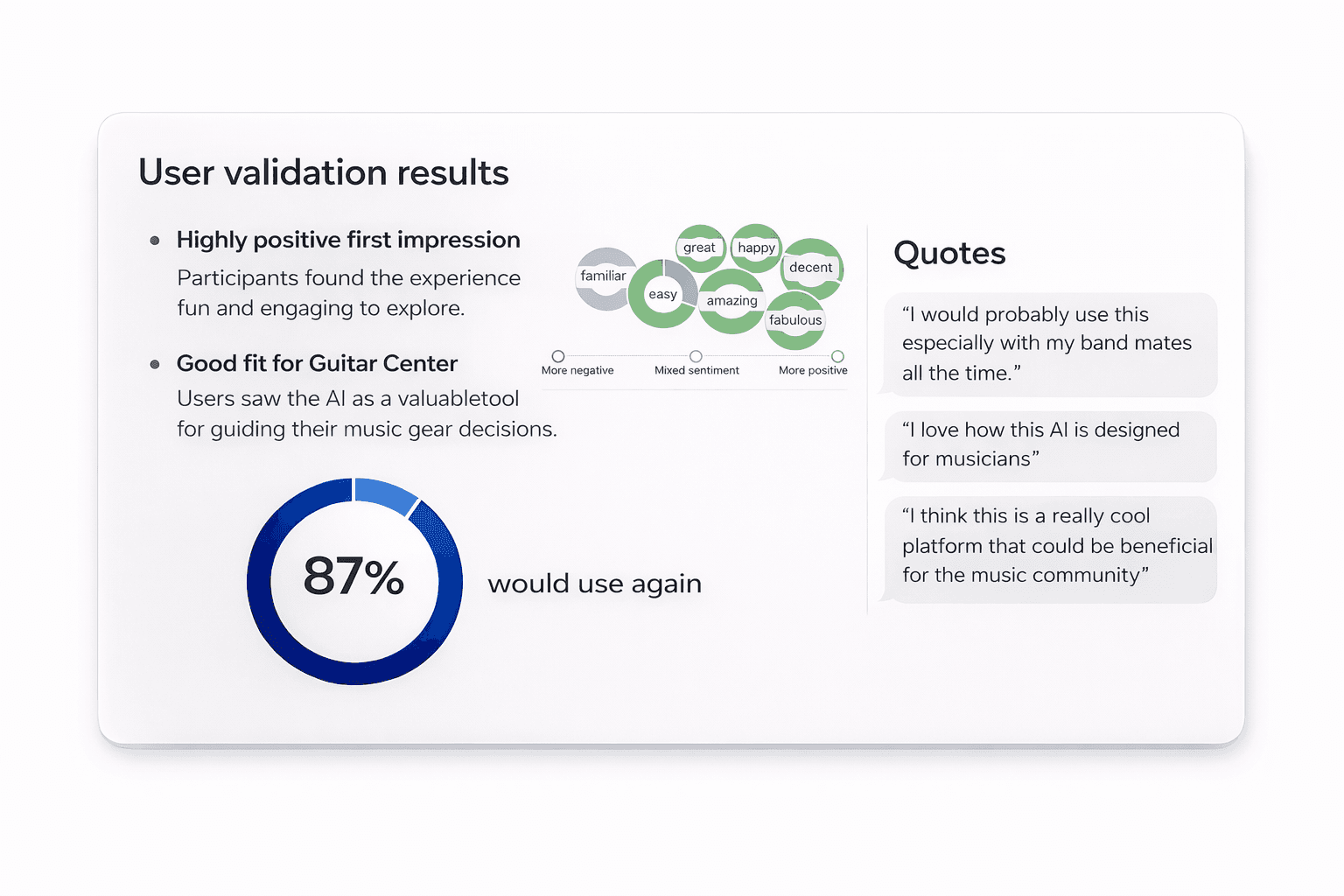
The strongest signal was not just positive sentiment, but clear evidence that musicians wanted to use the experience again.
Omnichannel concept
Based on the validated prototype, I explored how a unified AI experience could extend across Guitar Center touchpoints.
These visuals represent conceptual experience designs grounded in the prototype’s behavior and capabilities. They show product direction and experience exploration, not final production implementation.
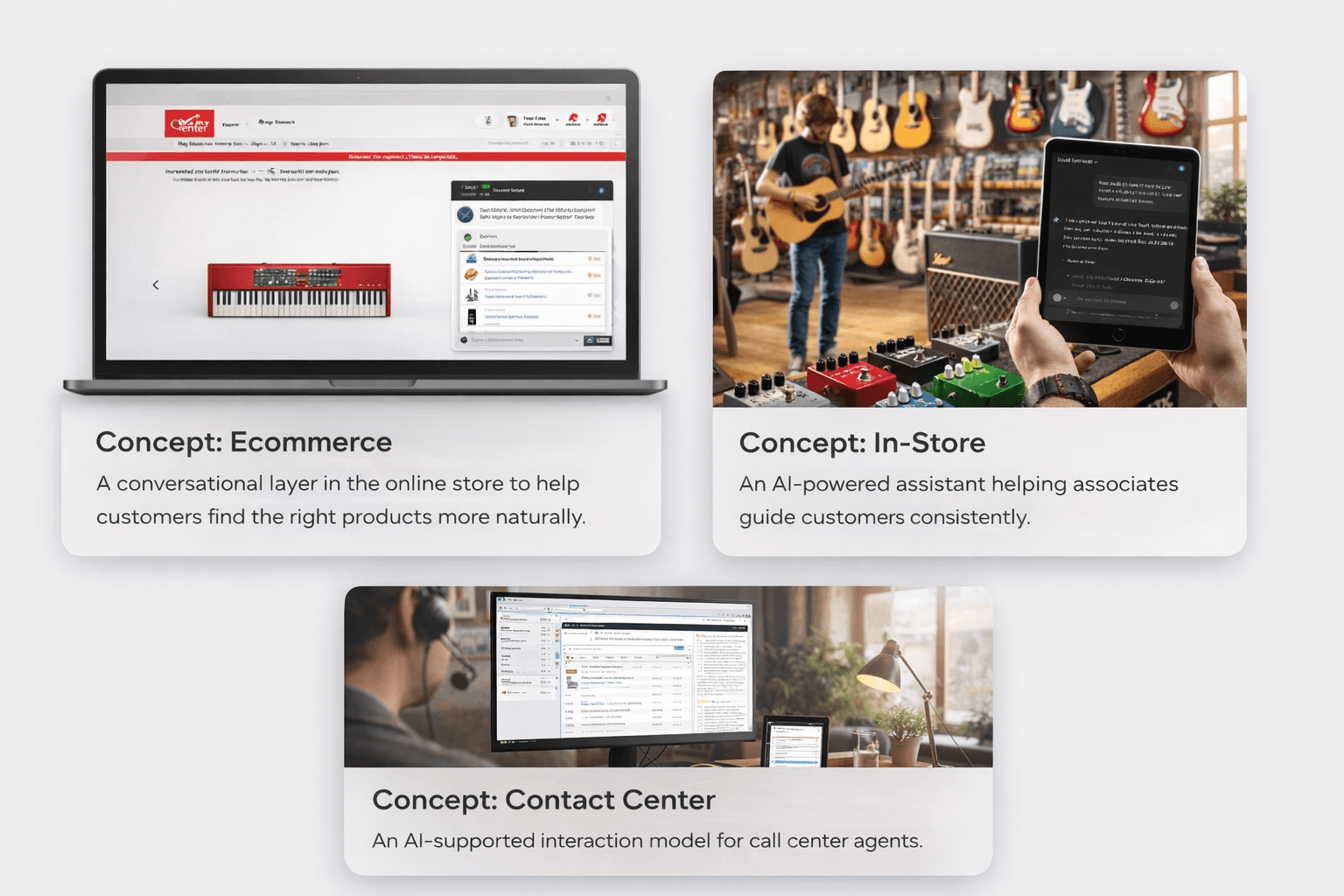
Conceptual experience designs grounded in the prototype's behavior and capabilities, not final production implementation.
A conversational layer embedded into the digital journey to help customers find the right products more naturally.
An assisted experience that could help store teams guide customers with more consistency and speed.
An AI-supported interaction model to help agents understand customer intent and respond with tailored guidance.
System design
The prototype validated value in a single interface. From there, I explored how the same AI layer could support product discovery across ecommerce, in-store, and contact center workflows.
01
I want to recreate the sound of [song, artist, or genre]. What do I need?
02
Underlying recommendation engine
01
Customers can discover gear recommendations inside the digital shopping journey.
02
Store teams can guide customers with a shared recommendation experience.
03
AI available to agents
Conversation context stored in Salesforce
03
I want to recreate the sound of [song, artist, or genre]. What do I need?
Underlying recommendation engine
Outputs
Customers can discover gear recommendations inside the digital shopping journey.
Store teams can guide customers with a shared recommendation experience.
AI available to agents
Conversation context stored in Salesforce
Influence
The concept generated strong internal interest and contributed to broader thinking around AI-enabled customer experiences.
While I did not own the final implementation path, the work sharpened my view of what it takes to move from early momentum to durable organizational value.
Key learnings
Why it matters
This experience shaped how I approach AI product work today: solve a real problem, validate quickly, and design the surrounding system so early value can become something repeatable and durable.
Recommendations
Two adjacent perspectives that reinforce the same pattern: translating early AI momentum into practical systems, stronger guardrails, and credible cross-functional execution.
At the forefront of our AI journey — crafted processes that enabled business efficiency while keeping data protected.
Sean worked with Daniel but on different teams
Sean Richardson
Information Security Leader
November 17, 2025
Shaped scalable ChatGPT integrations, multi-agent architectures, and enterprise guardrails into clear product strategies.
Daniel Kingston worked with Daniel on the same team
Daniel Kingston Thiruthuva Das
Senior Software Engineer @ The Guitar Center Company
September 29, 2025