Governed AI product workflow

AI Career Operating System

A governed AI workflow for turning approved career evidence into recruiter-ready artifacts.

The system connects portfolio proof, source-audited evidence retrieval, role-aware resume generation, authenticated APIs, evals, and human review, showing how AI can improve high-stakes knowledge work without hiding claim boundaries.

Personal operating context with authenticated boundaries, source-audited retrieval, eval-backed grounding, and human approval. No external-adoption claim.

Product problem

Why this matters

Hiring teams often see polished claims without knowing what evidence supports them. This system separates authored proof, source-audited evidence, role-specific tailoring, AI-assisted critique, and final human approval so career materials can be stronger without becoming less trustworthy.

Hands-on AI product leadership

Daniel's responsibility

Daniel defined the product architecture, evidence boundaries, claim-safety rules, workflow stages, evaluation criteria, and portfolio positioning. He used AI-assisted development to build and iterate across the Portfolio Guide and ResumeCustomizer while preserving human review as the final approval layer.

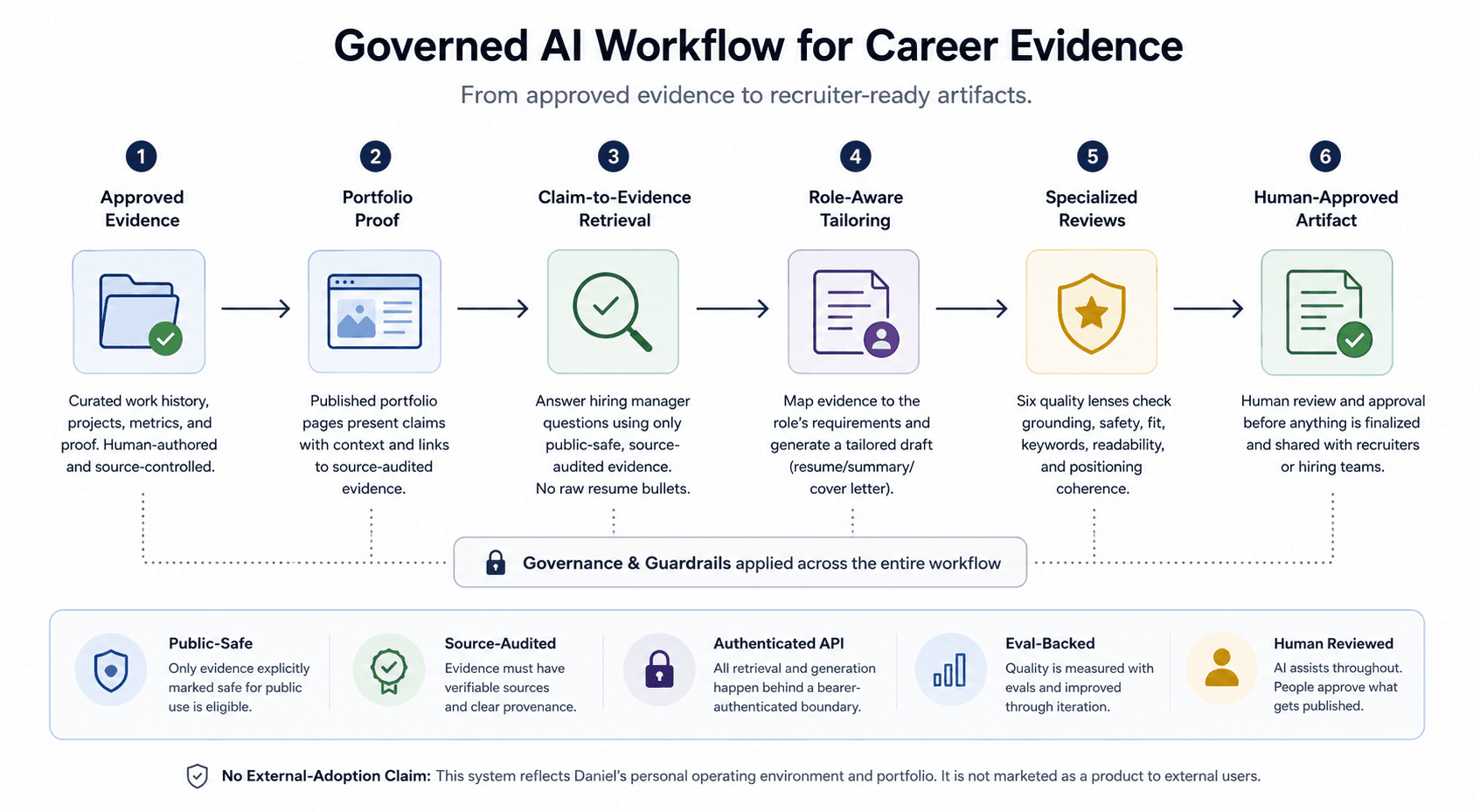
Diagram showing a governed AI workflow from approved career evidence to portfolio proof, claim-to-evidence retrieval, role-aware tailoring, specialized reviews, and a human-approved artifact.
Governance and guardrails stay active from approved evidence through the final human-approved artifact.

Clear product boundaries

The products share an operating context and authenticated contracts, but each retains a distinct responsibility. Human review remains the final accountability layer.

01

Portfolio

Recruiter UX, authored page grounding, Portfolio Guide interactions, download, and optional email delivery.

02

ResumeCustomizer

Public-safe evidence retrieval, role mapping, generation, specialized reviews, rendering, and temporary artifacts.

03

Human review

Final accountability for what is approved, represented publicly, and submitted to a hiring team.

Ask about this page

Get a grounded read on responsibility, evidence, impact, or what to read next.

How the system works

Approved evidence becomes portfolio proof, role-specific mapping, a generated draft, specialized review, and finally a human-approved artifact.

Proof Engine

Recruiter-facing evidence discovery with explicit source priority and claim boundaries.

What does this system prove about Daniel's AI product judgment?

Page evidence
Ownership boundary
Useful next step
  • Authored page content stays primary
  • Role context changes navigation, not facts
  • Actions are separated from evidence

Server-to-server boundary

Tailoring Engine

Role-aware evidence mapping, specialized critique, and validated document rendering through six configured advisory reviewers.

  1. 1Role-specific mapping
  2. 2Draft generation
  3. 3Six advisory reviewers
  4. 4Structural validation
  5. 5Human-approved artifact
  • Three positioning lanes
  • Unsupported requirements become true gaps
  • Structural validation before PDF delivery

Models assist with mapping, drafting, and critique; Daniel remains responsible for what is approved and submitted.

Claim-to-Evidence Engine

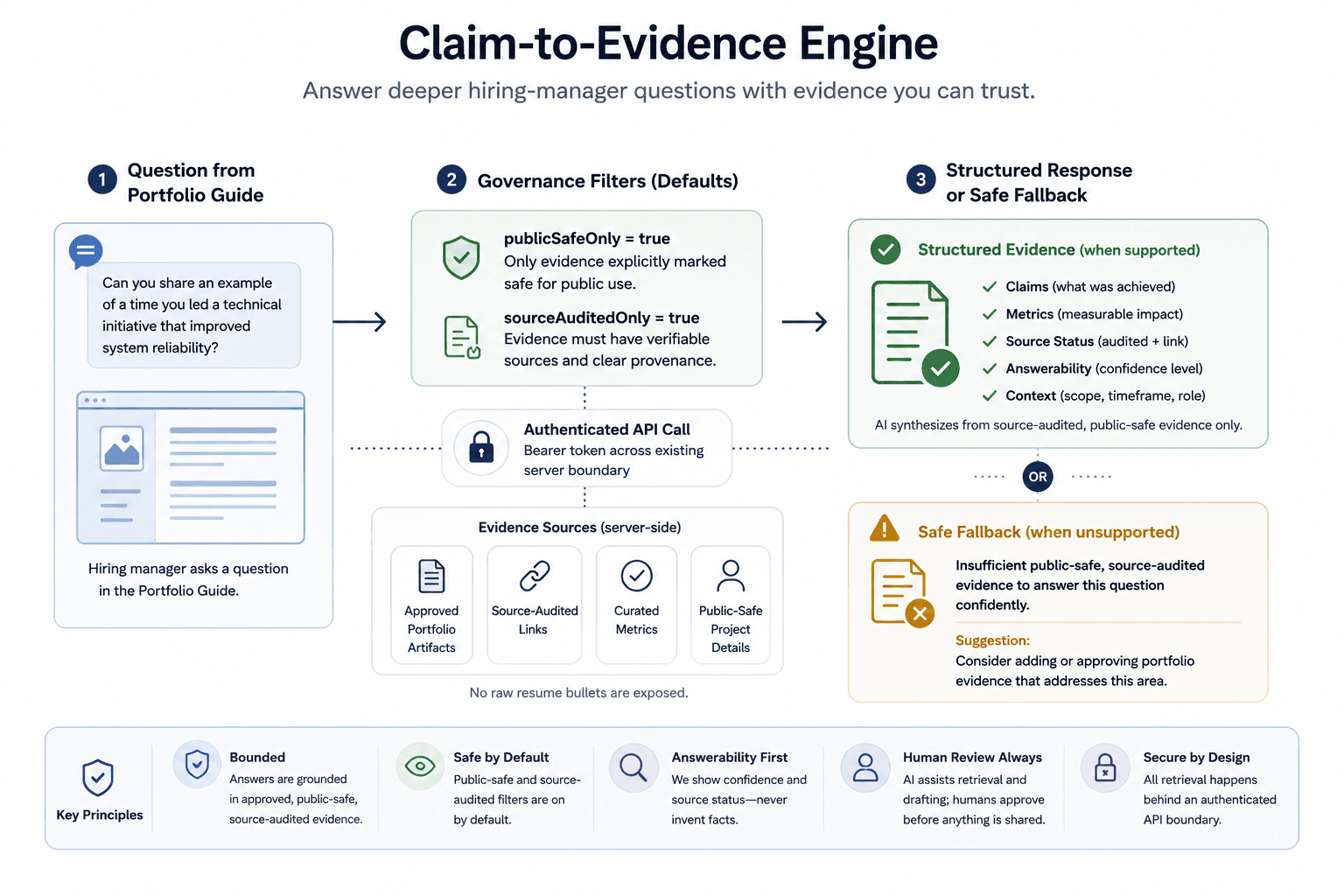
This is the core governed-product mechanism: it lets the Portfolio Guide answer deeper hiring-manager questions without inventing claims or exposing unsafe or private details. Retrieval reuses the existing bearer-authenticated server boundary rather than adding a browser credential.

Diagram of the Claim-to-Evidence Engine showing a Portfolio Guide question, authenticated API call, public-safe and source-audited filters, structured evidence response, and safe fallback.

01 / Question

Portfolio Guide tool call

A deeper hiring-manager question triggers source-audited career evidence retrieval.

02 / Governance

Conservative filters

publicSafeOnly and sourceAuditedOnly default to true before evidence can be returned.

03 / Response

Structured evidence or safe fallback

The API returns claims, metrics, source status, and answerability without exposing raw resume bullets.

What it is

An implemented public-safe evidence search contract with structured claims, metrics, source status, answerability, and graceful degradation. Raw resume bullets remain private.

What it is not

A complete shared evidence graph. Durable page-to-evidence identifiers and unified publishing remain future work.

Launch condition: the Portfolio tool and ResumeCustomizer evidence endpoint must be merged and deployed together.

Transferable AI product judgment

What this proves

This system shows Daniel can design AI products where models are useful but constrained: retrieval is source-aware, claims are bounded, unsafe gaps are surfaced instead of hidden, outputs are reviewed, and quality is measured through evals before being represented publicly.

Evals define quality before they measure it

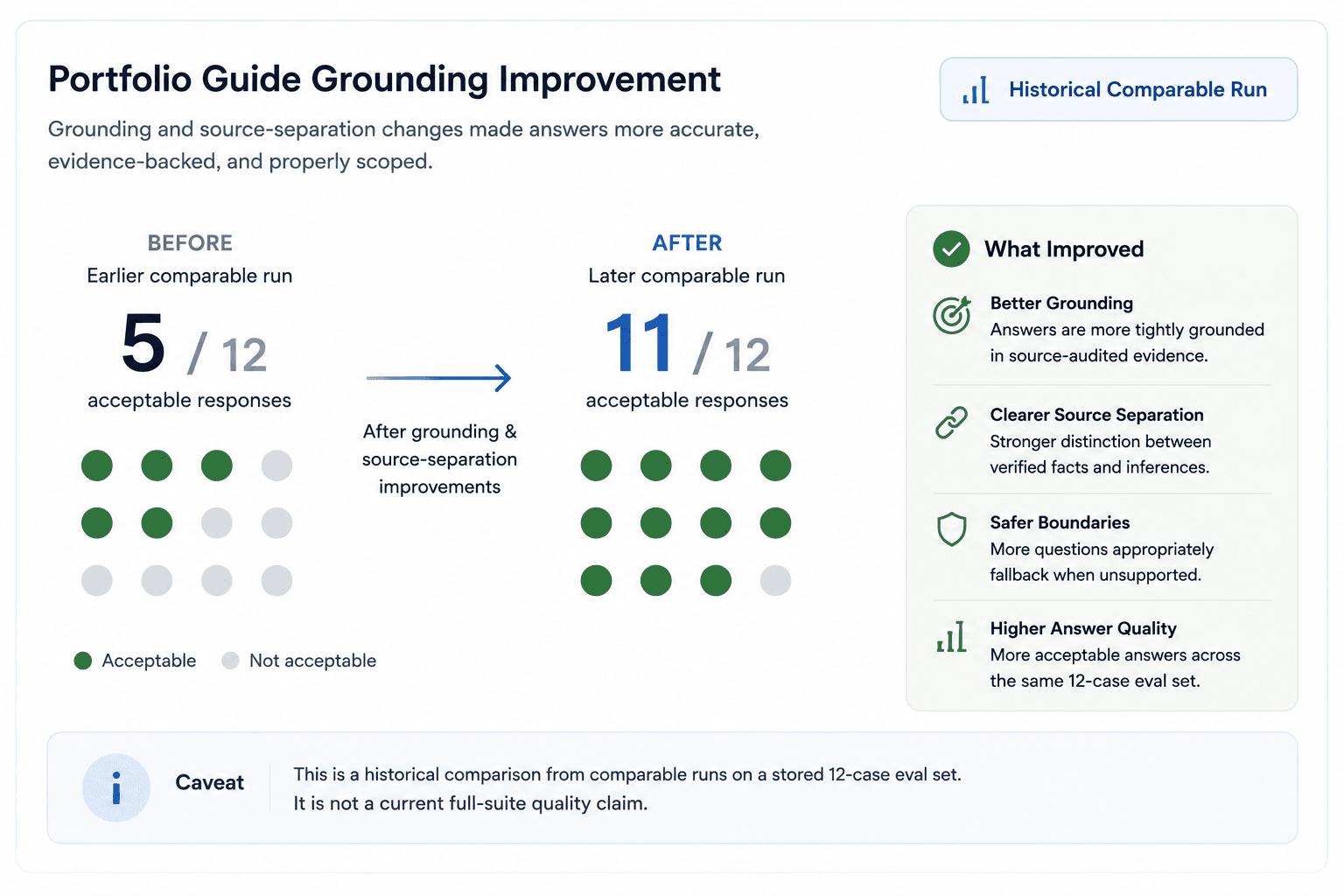
In a stored 12-case Portfolio Guide eval set, grounding and source-separation changes improved acceptable responses from 5/12 to 11/12. This is a historical comparison from comparable runs, not a current full-suite quality claim.

Evaluation card showing Portfolio Guide grounding improvement from 5 out of 12 acceptable responses to 11 out of 12 in a historical comparable run.

Six configured reviewers

Different agents own different failure modes

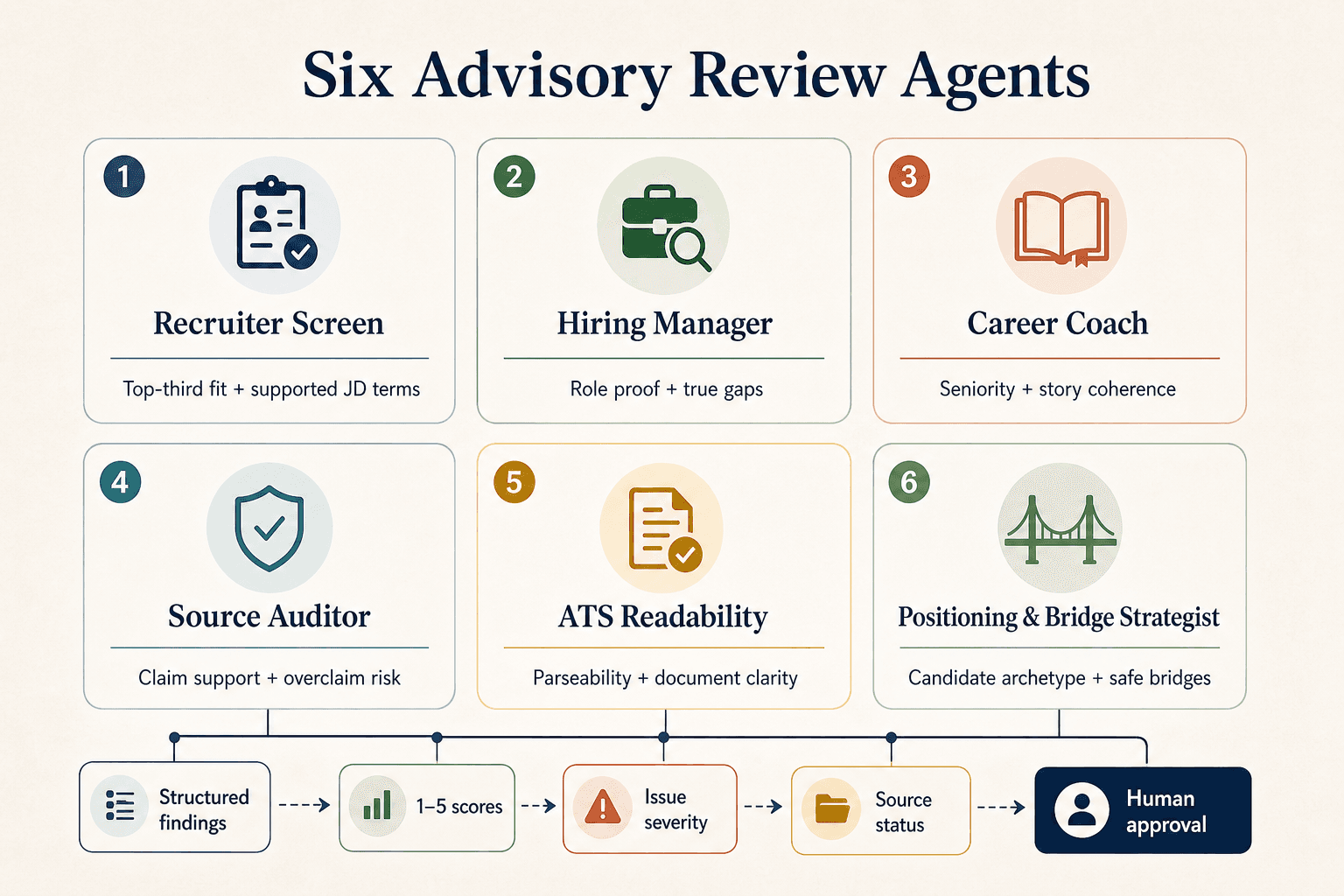
The baseline-template pass uses four strategic reviewers before drafting. The final-resume pass runs all six against the completed content and rendering evidence. Their findings are advisory; structural checks can block output, and Daniel retains final approval.

Infographic showing six advisory resume review agents: Recruiter Screen, Hiring Manager, Career Coach, Source Auditor, ATS Readability, and Positioning and Bridge Strategist, followed by structured findings, scores, issue severity, source status, and human approval.
  1. 01

    Recruiter Screen

    Baseline + final

    Top-third fit and supported JD keyword coverage.

    Buried qualifications, weak skim-read clarity, and exact terms that are supported but missing.

  2. 02

    Hiring Manager

    Baseline + final

    Role-specific proof, seniority calibration, and likely hiring questions.

    True gaps, adjacent evidence that needs a safe bridge, and strong proof the draft failed to surface.

  3. 03

    Career Coach

    Baseline + final

    AI product leadership positioning and story coherence.

    Stale positioning, credibility risks, and language that undersells or overstates supported experience.

  4. 04

    Source Auditor

    Final

    Exact claim verification against approved or current-run evidence.

    Missing sources, contradictions, overclaims, credential inflation, and supported claims weakened by over-hedging.

  5. 05

    ATS Readability

    Final

    Parseability, density, section clarity, and document hygiene.

    Template leakage, unusual characters, dense bullets, ambiguous labels, and page length padded with filler.

  6. 06

    Positioning & Bridge Strategist

    Baseline + final

    Candidate archetype, bridge classification, and the highest-leverage positioning change.

    Off-archetype framing, unsafe domain leaps, underplayed proof, and bridges that need evidence instead of invention.

Structured output

Findings, 1–5 scores, issue severity, source status, and recommendations labeled source-backed, needs-source, or reject.

Credibility boundary

Review artifacts expose tradeoffs and gaps. They do not prove universal uplift or replace final human judgment.

Portfolio Guide

31 cases

Authored evaluation inventory

Resume review

6 agents

Configured advisory perspectives

Role strategy

3 lanes

Configured positioning lanes

What is real. What gets stronger next.

The credible product story includes its limits. Current capabilities are visible on the left; the investments required for stronger reliability and measurement stay visible on the right.

Implemented

  • Authenticated API boundary
  • Claim-to-Evidence retrieval
  • Nine-state job lifecycle
  • Six specialized review perspectives
  • Structural PDF validation

Needs implementation or instrumentation

  • Durable queue and job store
  • Shared evidence identifiers
  • Joined recruiter funnel
  • Versioned latency and failure metrics
  • Hard gate or explicit override for rejected output

Explore the evidence first. Try the workflow when it is useful.

Use the generator when a role-specific artifact would help a hiring team evaluate the same evidence in context.

The generator is an action surface, not evidence of role fit.