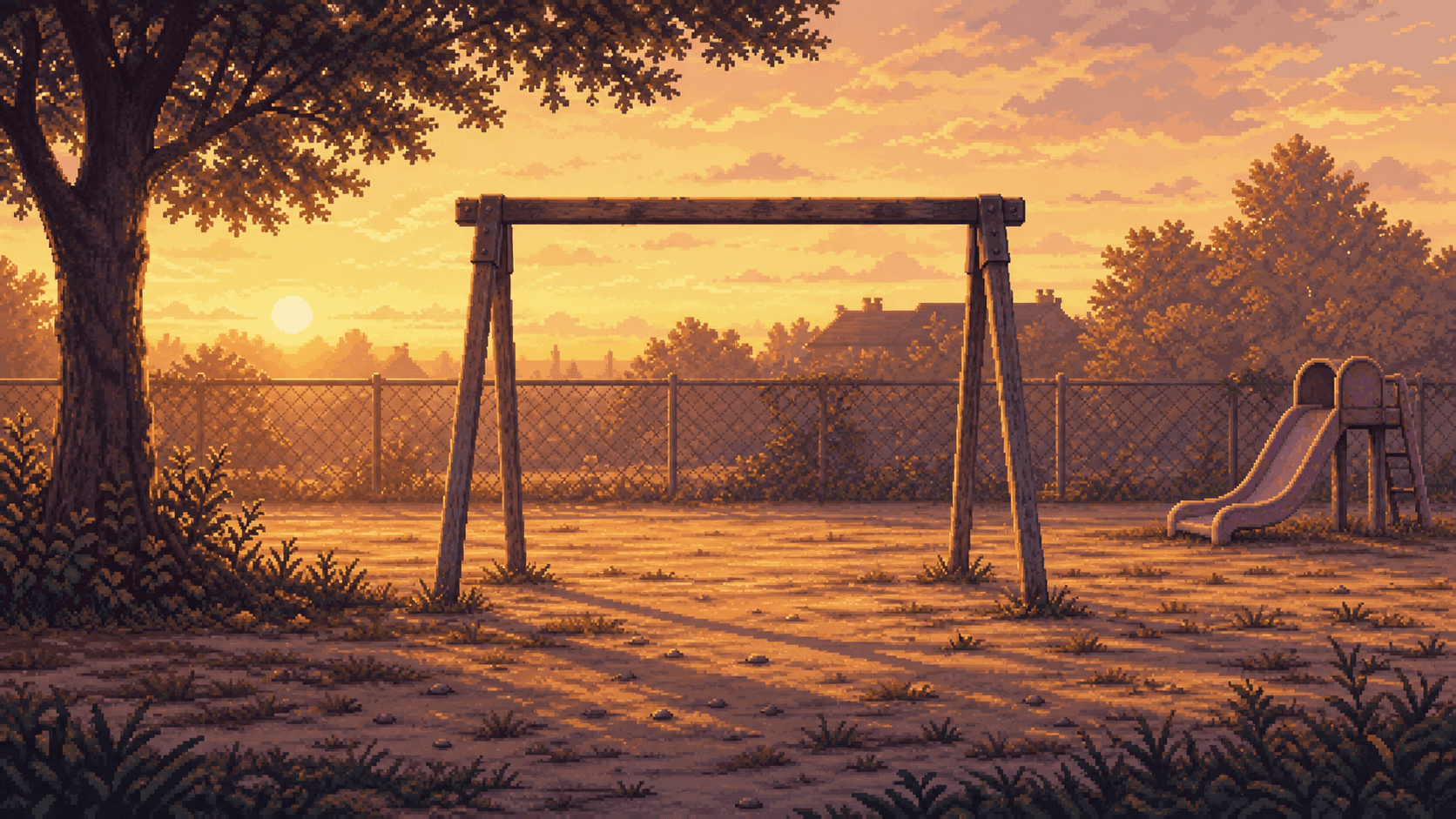
01
Back in the Swing
Build momentum, collect fireflies, and decide when to jump away from the safety of repetition.
Interactive album / browser game
An original album about ambition, burnout, recovery, and the loops we choose to re-enter—made playable across eight tactile chapters.
The whole idea, quickly
Eight non-looping songs become eight playable chapters. The music sets each chapter's duration and emotional shape; the mechanics let you inhabit the story instead of hearing it explained.
It is not a rhythm game, and the music is not interchangeable background audio. When a song reaches silence, the game opens a final action or choice—but never makes that choice for you.
Listen to the album
Stream the original 2018 album before you play, or return to it after experiencing how each track became a chapter.
The playable arc
The experience moves from comfortable repetition to risk, compulsion, collapse, recovery, and an ending that remains deliberately unresolved.
01
Build momentum, collect fireflies, and decide when to jump away from the safety of repetition.
02
Cross a narrow beam by reading the environment instead of relying on a conventional balance meter.
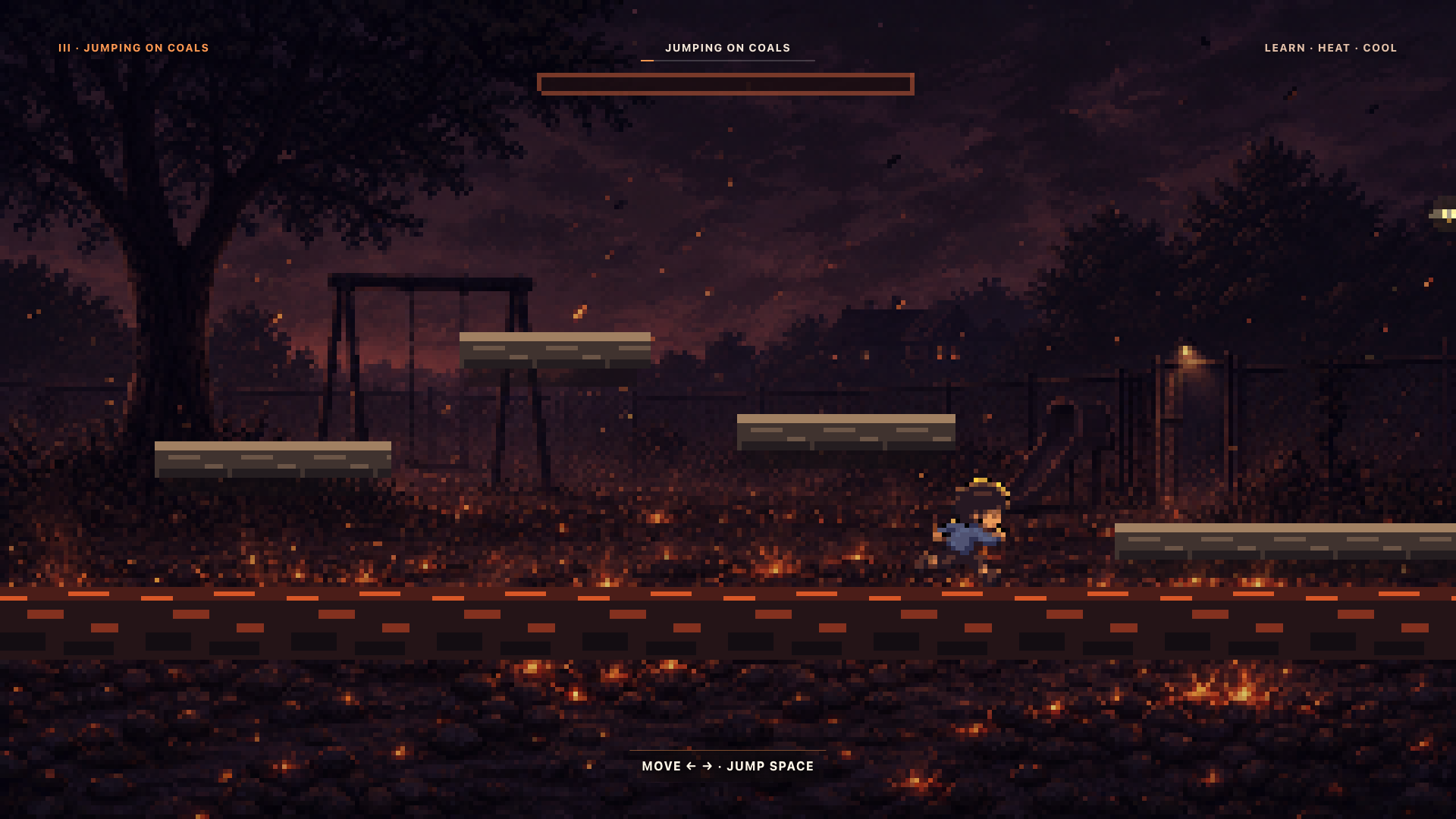
03
Manage Heat and Flow across a 26,400-pixel route while a wall of fire closes in behind you.
04
Keep working as productive effort quietly turns into compulsion, exhaustion, and collapse.
05
Use breath, focus, and memory to recover the ability to stand instead of treating recovery as another score.
06
Turn alternating shovel strikes into a difficult ascent through the same earth you once dug into.
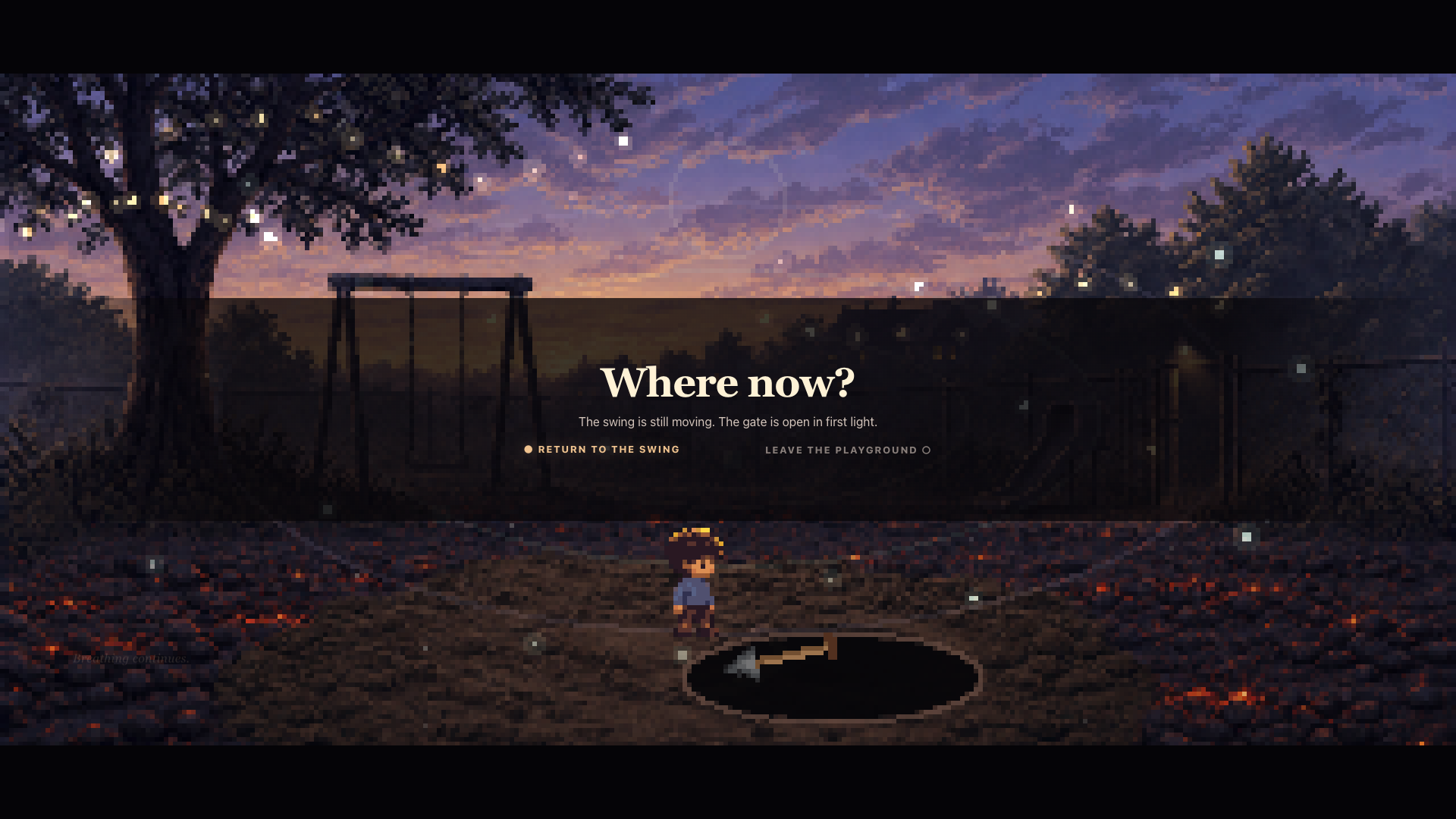
07
Rest beneath an opening sky, then choose whether to leave the playground or return to the swing.
08
Return to a satisfying familiar motion and decide for yourself when—or whether—to step away.
Why I made it
Years ago, I was putting nearly all of my energy into work. The work improved, but I was becoming angry, isolated, and creatively empty. I finally took my first paid PTO day on a Friday—and wrote the entire album over that weekend.
As I composed, a visual story appeared: a child leaves the safe repetition of a swing, lands on hot coals, digs down for relief, recovers at the bottom, climbs out, and has to decide whether to leave or begin the cycle again.
The full album uses one cello pizzicato transformed through different effects: one person moving through many emotional states. The game follows the same idea.
From idea to playable work
I had imagined an interactive version for years, but did not have the game-development background or budget to make it. With ChatGPT, I first translated the concept into a game design document, then used Codex to attempt a Phaser prototype. The first three chapters existed, but the physics, visuals, and full arc were not yet working together.
During OpenAI Build Week, I returned to that foundation with Codex and GPT-5.6. The work expanded the stalled three-chapter prototype into the complete eight-chapter experience, while I continued directing the mechanics around the album's emotional purpose and how each interaction felt to play.
Already existed
The original eight-track album, central metaphor, creative direction, Phaser foundation, and rough three-chapter vertical slice.
Build Week transformation
Six later scene implementations, rebuilt swing and balance, the long coal route, recovery and escape chapters, the leave/return loop, responsive presentation, touch controls, and browser-ready audio.
Watch first
The Build Week demo shows the arc, the mechanics, and the before-and-after story in 2:45. The complete explanation is below if you want the personal and creative context too.
Watch on YouTubeOptional deep dive
This is my full, uncut 16-minute Build Week explanation: how the album came from burnout, how the visual metaphor formed, why the first prototype stalled, and what changed when the complete game finally became possible.
Jumping on Coals: complete explanation
Original recording / web-compressed / untrimmed
0:00
Work, the first PTO day, and the weekend the album appeared.
1:55
Safety, momentum, burnout, the hole, recovery, and return.
4:26
How a single cello pizzicato became the entire sound world.
5:56
The early GDD, prototype, visual experiments, and false starts.
9:54
Why the existing foundation was kept and how the full arc emerged.
11:52
Mechanics that sustain attention without turning it into a rhythm game.
14:09
What the work is meant to make players feel and discuss.
Your turn
Play the full eight-chapter experience in your browser. No install required; headphones make the album's arc easier to feel.