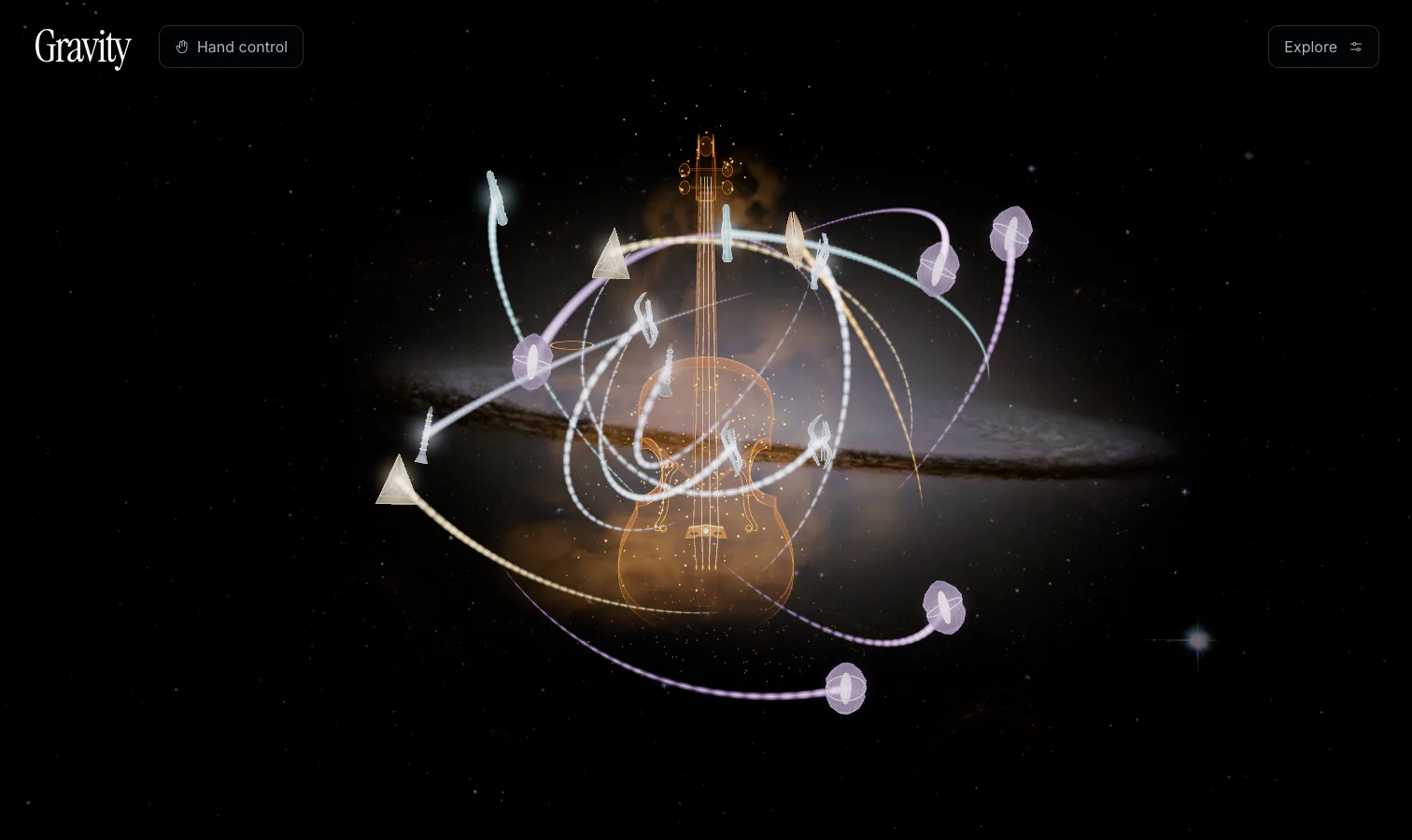
Gravity × Astra
Gravity
More capable. Less complicated.
Astra helped me push a browser composition into a navigable 3D spatial instrument. Testing taught me where to pull back.
The second build
Astra widened the possible.
The first browser version proved the composition could work: independent performers, spatial audio, and two views of one gravitational system. With Astra, I could work at the scale of the whole experience rather than one feature at a time.
A product observation could become a revised interaction rule, a physics and audio change, a visual treatment, a browser test, and a documented decision in the same working loop. That made a much more ambitious version practical—but it did not make every ambitious idea good.
- 01
- A space you can enter
- Free movement, cello and performer perspectives, and an audible listener position turned the field from a scene into a place.
- 02
- Orbits with real depth
- Each performer now moves through its own trajectory-defined orbital plane. The renderer and spatial-audio engine read the same position.
- 03
- Three-dimensional worlds
- The static Atomic and Celestial backdrops became complete environments, with four quantum regions and four galaxies staged at different distances.
- 04
- Blender-built musical bodies
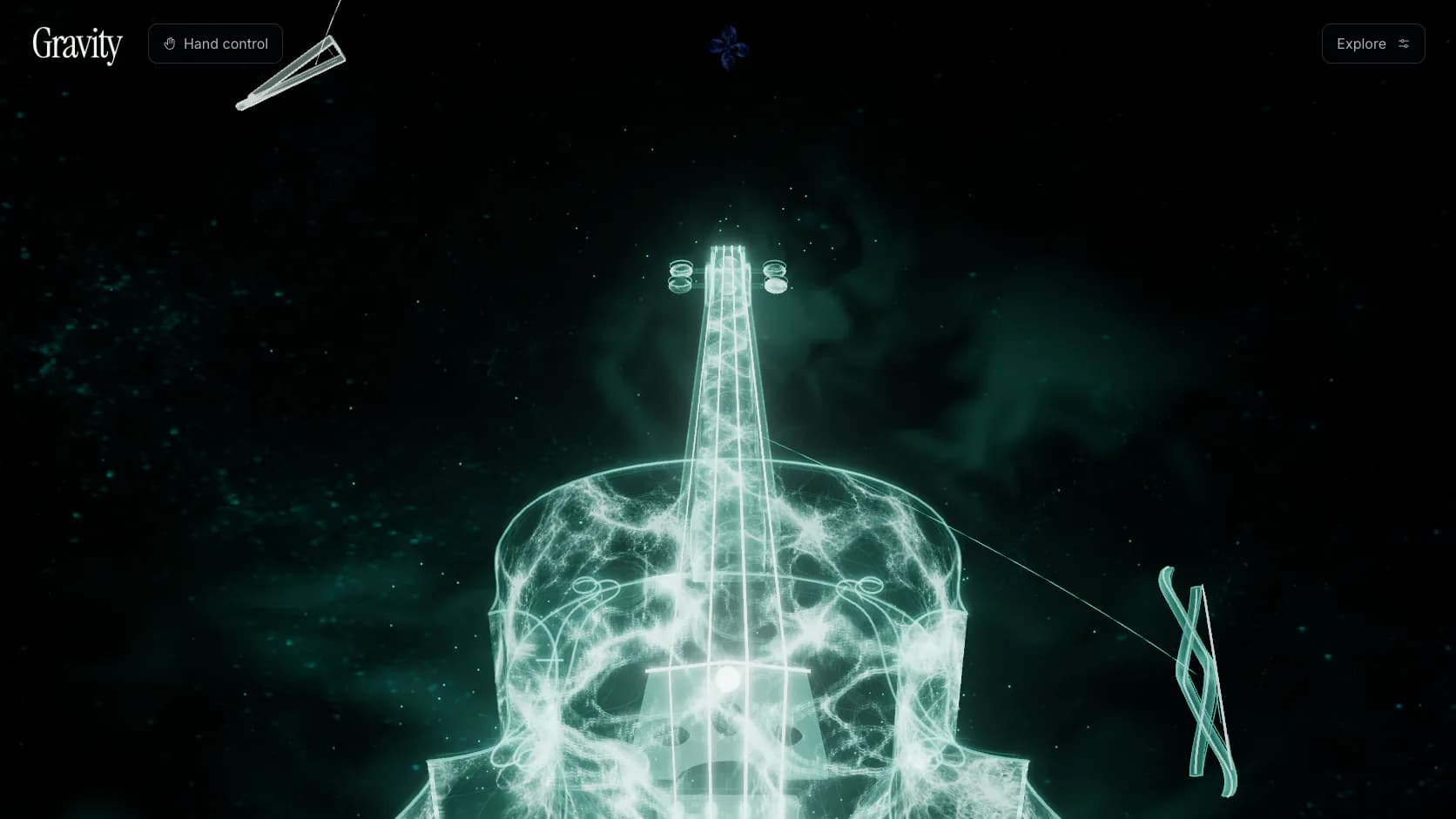
- Astra made Blender part of the working loop. The cello and six mobile instrument types gained stronger 3D forms, better animation, distinct silhouettes, and a textured cello surface.
- 05
- An embodied input layer
- Local webcam processing lets a visitor point, grab, follow, turn, zoom, and launch new sounds while keeping mouse and keyboard controls intact.
- 06
- A way to study the experience
- Local session recording pairs Gravity audio and a camera inset with a timestamped event log, making interaction problems observable instead of anecdotal.
The Blender turn
Better objects made the flat world feel wrong.
As soon as the instruments had volume, the world around them had to gain depth.
Astra made it practical to bring Blender into the working loop—not as a detached asset pass, but as part of continuous product iteration. I could improve the cello and mobile instruments, bring those assets back into the browser, and judge the models, motion, material, lighting, and audio together.
That changed the ambition of the environment. A static, flat background could no longer support objects that looked and moved in three dimensions, so the backdrop became a navigable 3D space with galaxies positioned at different depths.
- Model01
Recognizable bodies
A Blender-authored cello and instrument family replaced flatter geometric approximations with more convincing three-dimensional forms.
- Surface + motion02
Texture that could move
The cello gained a material texture, while stronger animation made each instrument feel like a body traveling through space rather than a marker crossing a screen.
- World03
Depth all the way out
Once the objects had volume, the static backdrop broke the illusion. Atomic and Celestial became 3D environments with galaxies placed at varying distances.
This was not a decorative background upgrade. The assets became convincing enough to require a more convincing world.
60-second film
Reach into the music.
The product decisions become clearer when the whole system is moving.
This short film moves from hand-launched sounds to independent orbits, listener navigation, performer follow, and the two three-dimensional worlds enabled by the Astra-and-Blender build.
Read the film transcript
- 00–08Reach into the music. Grab a sound. Pull back. Let go.
- 08–15Every shape carries a sound. Independent musical patterns, pulled into orbit.
- 15–22The cello is the center. The other performers move around it, each in their own time.
- 22–31Move through the music. Two hands change where you listen.
- 31–39Hear it from inside the orbit. Grab a performer to follow its journey.
- 39–47One composition. Two worlds. Point to both sides: Celestial becomes Atomic.
- 47–54Astra opened a new creative door. Music × Blender × hand tracking × spatial audio.
- 54–60Gravity. Reach into the music.
The earlier signal
One tester tried to move through the music.
While I watched people use the earlier version, one person treated the field like a place. They wanted to navigate through it, not just switch views from outside.
That instinct clarified the product direction. Perspective was not a camera feature; it was part of the composition. Moving closer to a performer should change both what you see and what you hear.
Product decision
Build Free view, dimensional cello and performer perspectives, and one shared visual-and-audible listener pose.
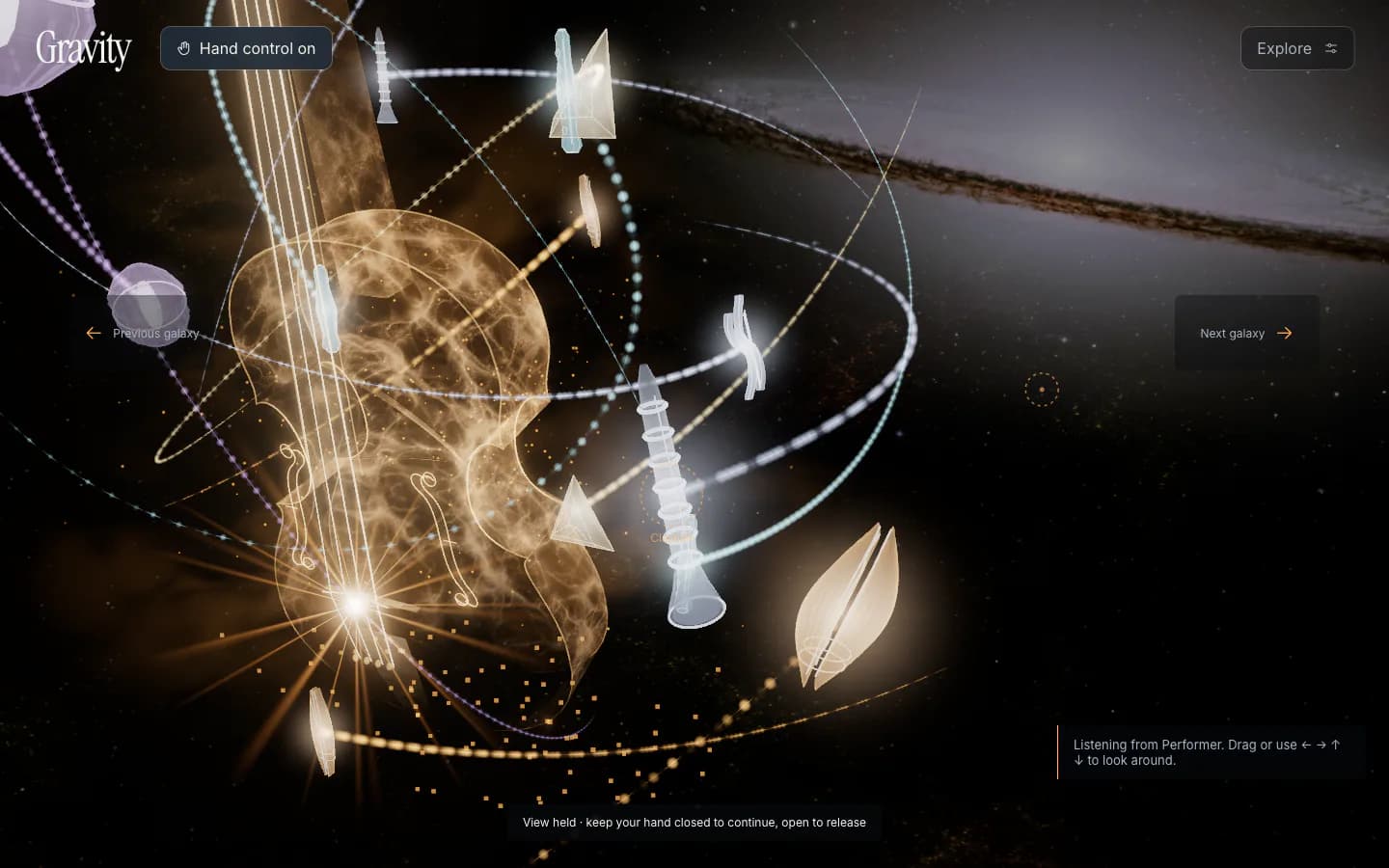
The listener can follow an autonomous instrument while its audio continues to move from the same rendered position.
The five-year-old test
The magic was making it clunky.
The clearest signal came from frustrating my five-year-old.
Waving to change worlds sounded natural. In use, it was inconsistent, slow to confirm, and too easy to confuse with ordinary movement. The full gesture set asked a visitor to remember too much while waiting to learn whether Gravity had understood them.
I first treated that as a recognition problem. Testing showed it was a product problem. More gestures did not create more agency; they created more uncertainty. So I pulled back.
World switching
Wave or use broad two-hand expansion and contraction gestures.
Point at the two visible side controls together, or choose a world in Explore.
Holding and launching
Depend on a precise pinch and let finger closure move the cursor.
Use a relaxed grab, anchor the target before closure, and move with the palm. Pinch remains an alternate input.
Feedback
Ask the visitor to infer whether the system understood them.
Show the target, dwell progress, spring tension, release state, and a clear path to cancel.
Scope
Treat a larger gesture vocabulary as a more magical experience.
Ship a smaller reliable grammar. Keep swipes and full-hand world gestures as documented experiments.
Waving, palm swipes, and full-hand world switching remain useful research. They are no longer the default product.
The live grammar now favors visible pointing, relaxed grabbing, explicit dwell progress, and conventional controls that remain available alongside the webcam.
Before / after
The change is easier to see.
The original MVP established the musical system. These paired runtime captures show where the Astra-and-Blender build added depth, material presence, and a stronger sense of place.

Original build
One legible field
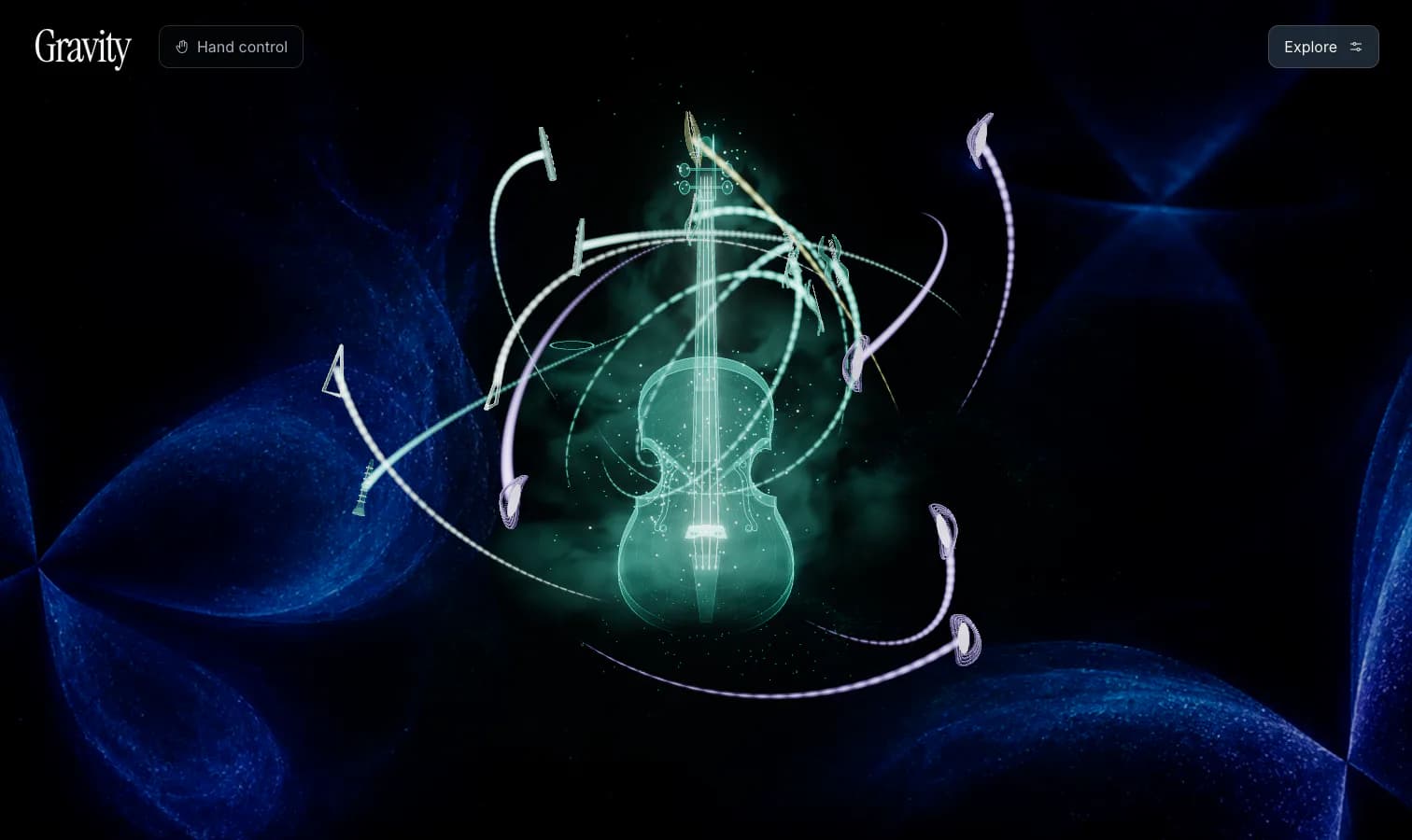
Astra + Blender
Individual spatial orbits


Slide 01 / 03
From a field to spatial behavior.
The first build made performer motion legible from the audience. Blender-built instruments and stronger animation now travel through paths that the renderer and spatial mix both understand in three dimensions.
What stayed ambitious
Simpler control. A much richer instrument.
Pulling back on gesture novelty created room to deepen the parts that actually make Gravity feel alive.
Spatial orbits
Performers no longer share a flat stage. Their individual orbital planes feed both the scene and the spatial mix.
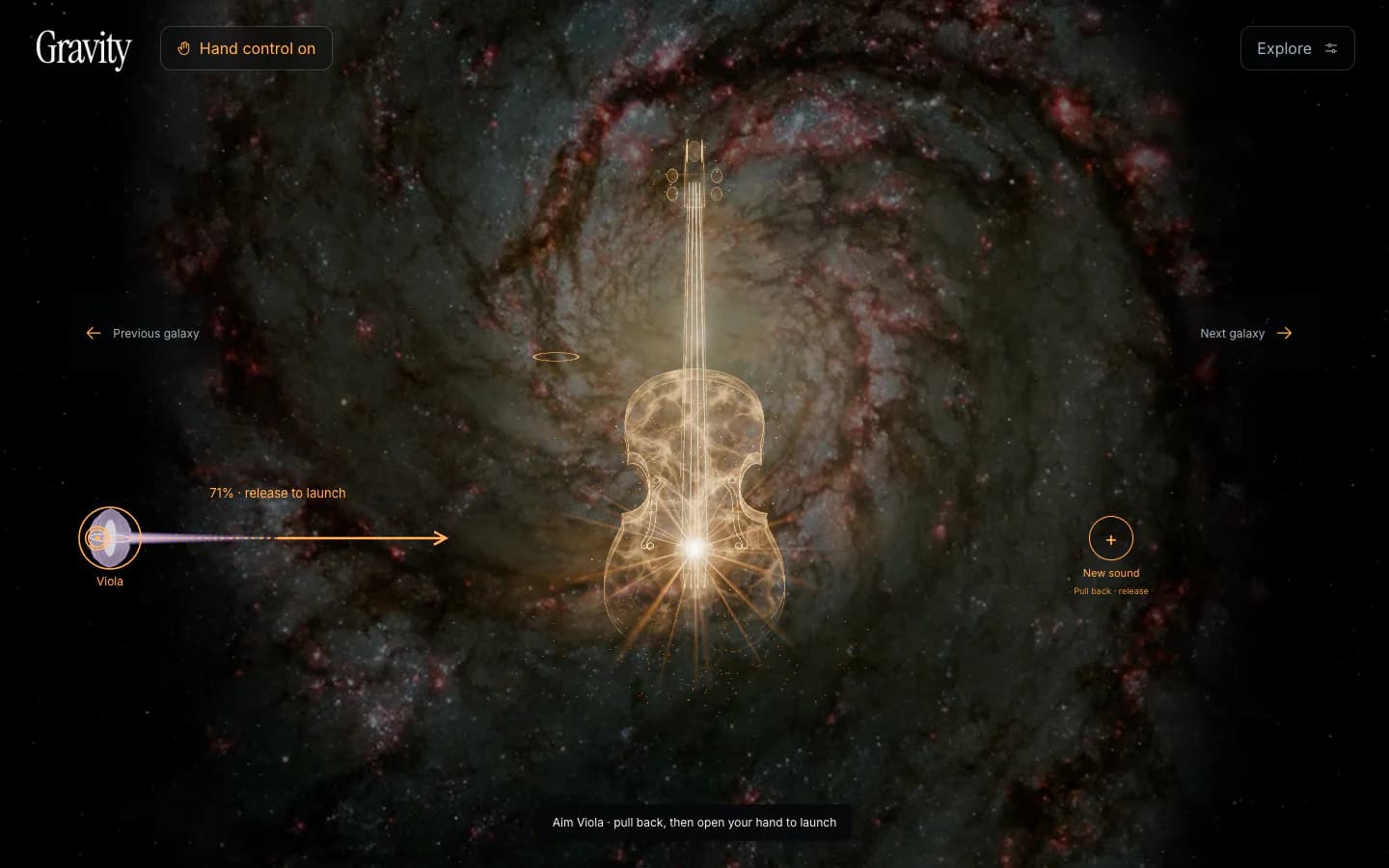
Physical invitation
A visible spring makes the grab, pull, and release model legible—and turns launch direction into musical physics.
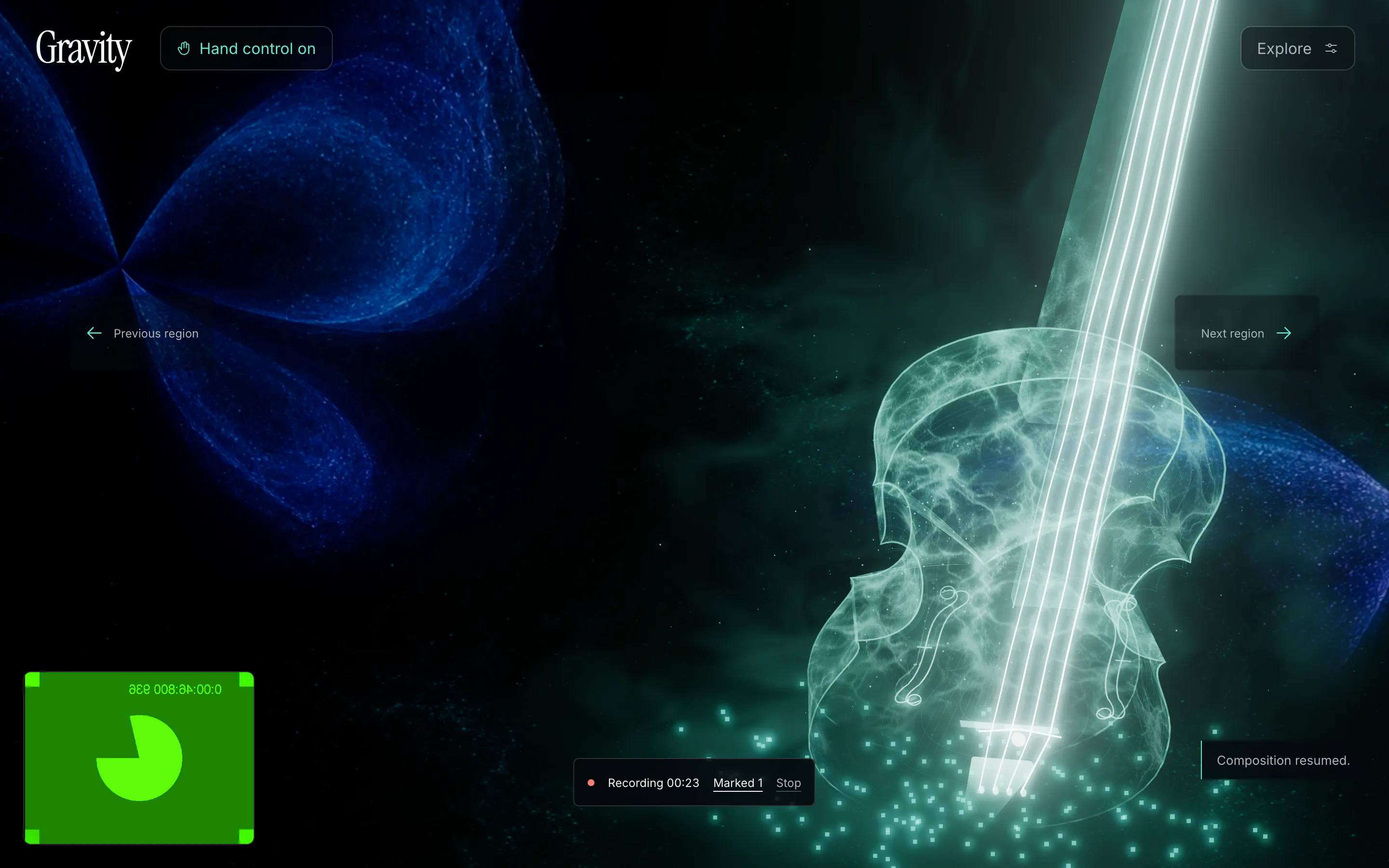
An evaluation instrument
A local recording and matching event log make recognition delays and misunderstood intent inspectable after a session.
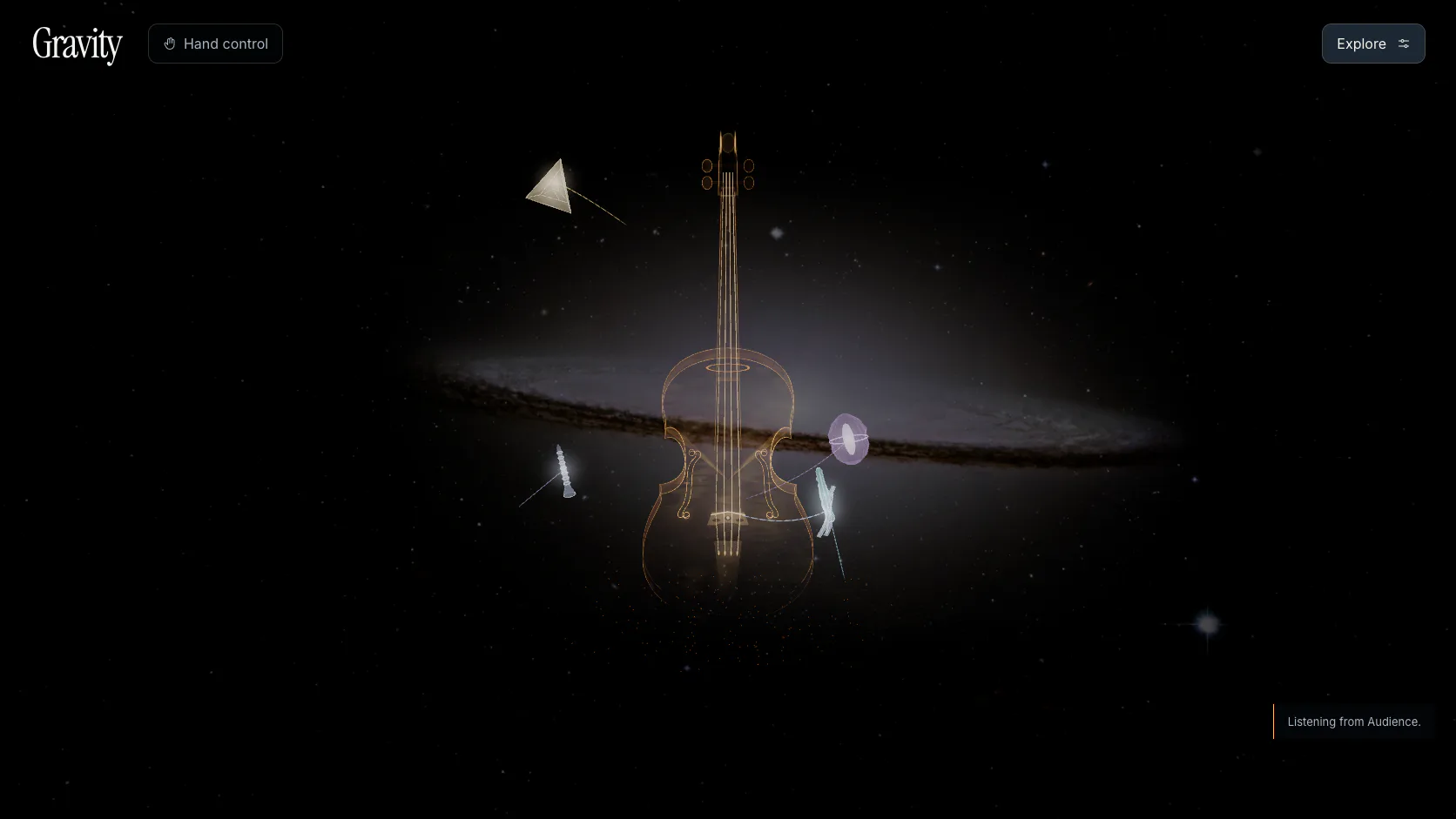
A composed ending
After the final audio tail, the cello dissolves into starlight. Replay rebuilds the instrument without changing the visitor's chosen world.
My approach
Direct the system. Test the feeling.
Astra changed the scale and continuity of the collaboration. It could carry a decision across a large, interdependent product. My job was to keep deciding what the product should become.
- 01
Turn the artistic intent into a contract.
I kept the PRD as the center of the work: the cello stays fixed, performers stay autonomous, and every visible position must agree with what the listener hears.
- 02
Let the medium change the stack.
Astra made it practical to bring Blender into the iteration loop, carry richer assets into the browser, and judge the models, motion, materials, and environment as one experience.
- 03
Ask for whole-system changes.
With Astra, a product observation could travel through interaction rules, physics, rendering, audio, accessibility, documentation, and tests in one connected loop.
- 04
Inspect the experience, not just the code.
I used browser captures, full-session recordings, event logs, performance profiles, and repeatable regressions to see where the rendered behavior diverged from the idea.
- 05
Let people overrule the prototype.
Synthetic tests could prove that a gesture fired once. They could not prove that it felt immediate, comfortable, or worth learning. Human behavior made the final call.
Astra accelerated
Blender-to-browser asset iteration, cross-system implementation, edge-case exploration, and a deeper automated-and-browser validation loop.
I remained responsible for
The composition, product thesis, experience principles, human observation, tradeoffs, and the call on what deserved to ship.
The result
Better because I knew what to remove.
Gravity is now a deeper spatial world with dimensional, textured instruments, a more expressive musical system, and a more honest interaction design. The model expanded the build. Watching people use it sharpened the product.